Inspiration is an invaluable tool for the essential minds (like yours) that will shape the future of humanity. It has been learned that the smallest ideas or actions have had monumental effects on the world in which we live. As a lover of metaphysics, psychology, arts, exercise, and education, I have created this blog to inspire readers and promote global change for the better. It is my goal to give readers points of inspiration and the knowledge they need to make excellent changes in their lives and the lives of their acquaintances. I invite you to use this blog as a jumping point. Beginning at the substratum, leaping up through the stratosphere. Let this page be a foundation that you can continuously check back with as a resource for better living.
I encourage thoughtful conversation and would like to hear the voices of my readers (yes I mean you!). If there is a particular topic you would like to hear about, do not hesitate to ask!
Learn the difference between spruce and pine trees using needles, cones, bark, and branches, with simple identification tips you can use outdoors.
Walk through almost any northern forest or suburban neighborhood and you’ll probably encounter trees you casually call “pine trees.” But many of them aren’t pines at all.
Spruce and pine are both evergreen conifers, and from a distance they can look remarkably similar. Up close, however, they have several characteristics that make identification surprisingly easy.
The best part is that you don’t need to be a botanist. Once you learn to look at the needles—especially how many grow from each attachment point—you can often distinguish a pine from a spruce within seconds. Learning these small details can also make an ordinary walk through the woods feel much more interesting.
Spruce vs. Pine: The Basic Difference
Pines and spruces belong to the same botanical family, Pinaceae, which also includes firs, larches, hemlocks, and cedars of the genus Cedrus.
But they belong to different genera:
Pine:Pinus
Spruce:Picea
Both produce cones rather than flowers and fruits in the way broadleaf trees such as maples and oaks do.
Both also usually retain their needles throughout the winter.
The easiest way to distinguish them isn’t their overall shape. It’s their needles.
Pine Needles Grow in Bundles
If you remember only one identification trick, remember this:
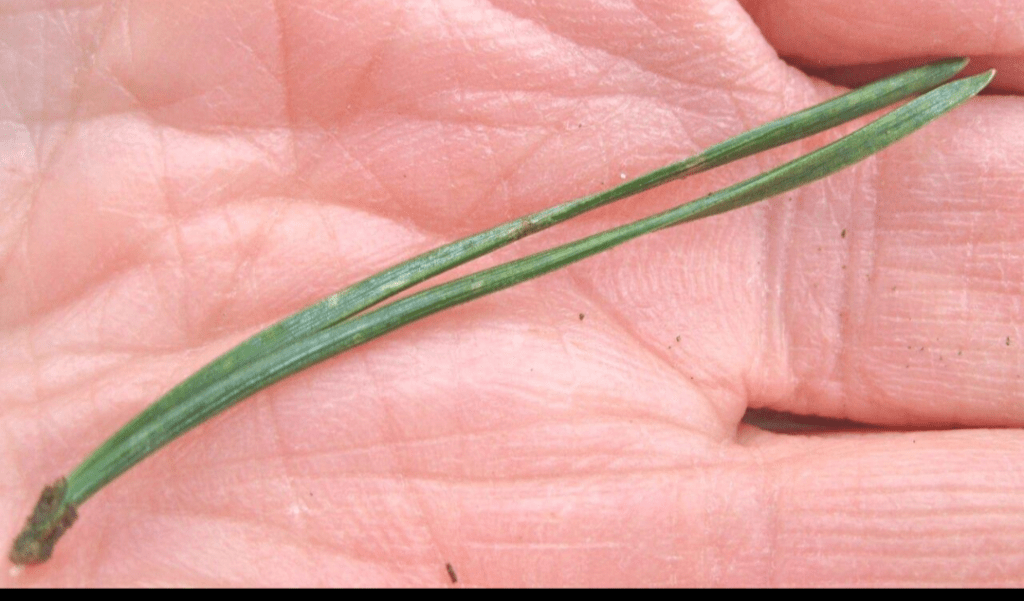
Pine needles grow in bundles.
These bundles are technically called fascicles.
Depending on the pine species, each fascicle commonly contains two, three, or five needles.
For example:
Eastern white pine usually has five needles per bundle.
Scots pine usually has two needles per bundle.
Red pine usually has two needles per bundle.
Pitch pine commonly has three needles per bundle.
This makes needle counting an excellent starting point for identifying individual pine species.
Pine needles also tend to be relatively long and flexible compared with spruce needles. Some species have needles several inches long that bend easily between your fingers.
A Simple Pine Memory Trick
Think:
Pine = Packets
If several needles emerge together in a little packet or bundle, you’re probably looking at a pine.
Spruce Needles Grow Individually
Spruce does something very different.
Instead of growing in bundles, spruce needles attach individually to the branch.
Look closely at a spruce twig and you’ll see one needle emerging from each attachment point.
Spruce needles also tend to be:
Shorter than many pine needles
Stiffer
Pointed
Somewhat prickly
Square or four-sided in cross-section
Try gently rolling a spruce needle between your fingers. Many spruce needles roll surprisingly easily because they’re roughly four-sided rather than flat.
They can also feel noticeably sharp when you grab a branch.
A useful memory trick is:
Spruce = Single and Spiky
Single needles plus a prickly texture strongly suggest spruce.
Look at the Branches, Too
The twigs provide another excellent identification clue.
Spruce needles grow from tiny woody projections called sterigmata.
When a spruce needle falls off, the little peg remains behind.
As a result, older spruce twigs often feel noticeably rough or bumpy when you run your fingers over them.
Pine needles don’t leave the same collection of woody pegs.
So if you’re examining an unknown evergreen, look at an older section of twig where some needles have fallen.
A rough, peg-covered twig strongly suggests spruce.
Pine Cones vs. Spruce Cones
Cones provide another useful clue, although their appearance varies considerably among species.
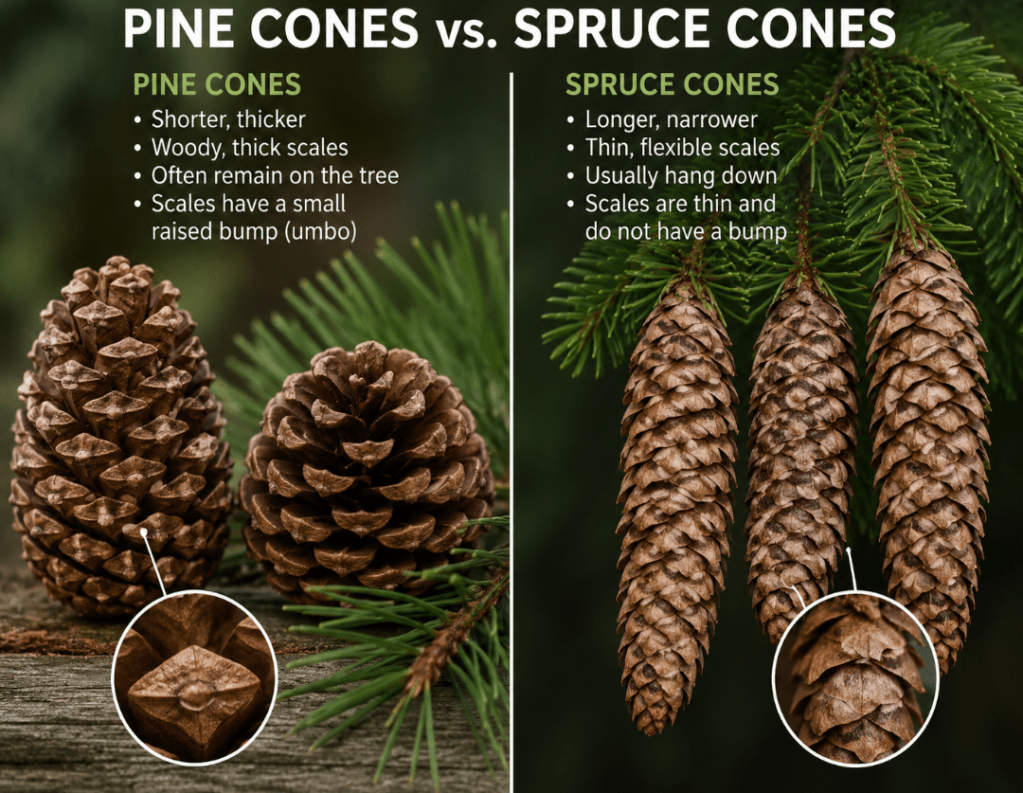
Pine Cones
Pine cones often have relatively thick, woody scales.
Depending on the species, they may be:
Small and rounded
Long and cylindrical
Heavily armored with thick scales
Smooth or somewhat prickly
Some pine cones can remain attached to a tree for years.
Spruce Cones
Spruce cones generally:
Hang downward from branches
Have thinner scales
Feel lighter and more flexible
Are often elongated or cylindrical
If you find an intact cone beneath the tree, gently squeezing it can sometimes help.
A thick, hard, woody cone suggests pine, while a lighter cone with thinner scales may indicate spruce.
What About the Shape of the Tree?
Tree shape can provide clues, but it isn’t as reliable as examining the needles.
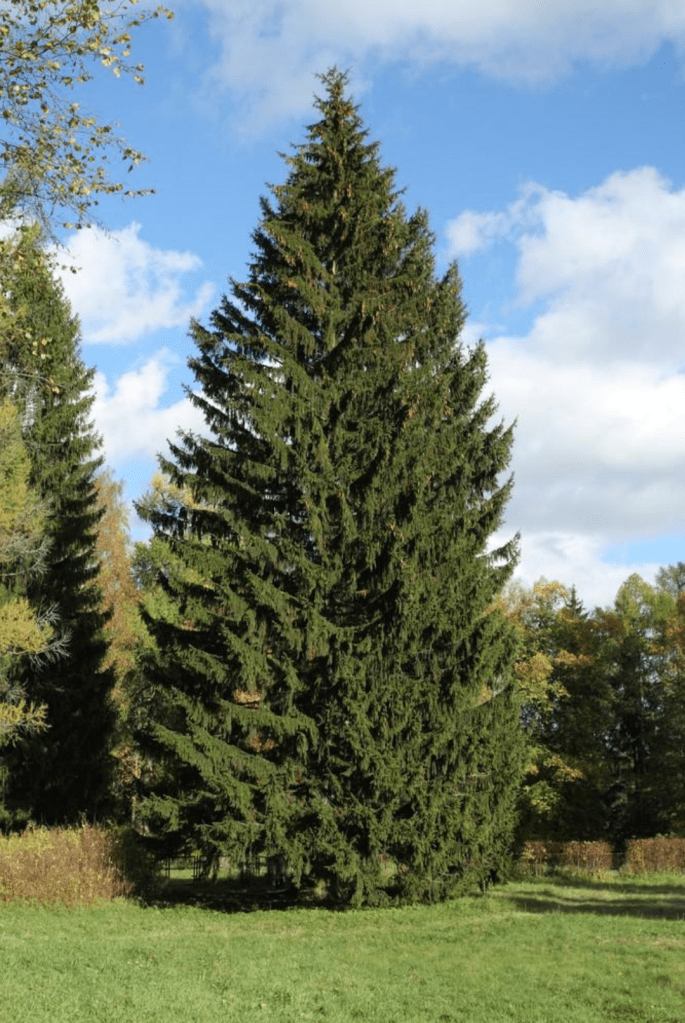
Spruce trees frequently develop the classic Christmas-tree shape—a narrow, symmetrical pyramid with branches arranged around a central trunk.
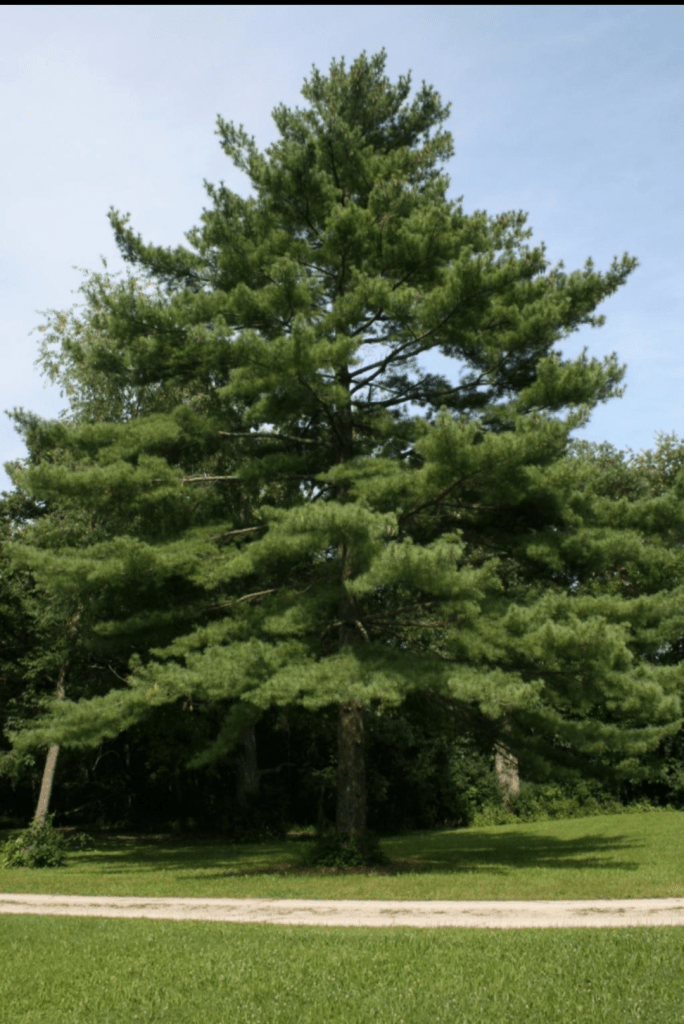
Many pines become less symmetrical as they mature.
Older pines can develop broad crowns, irregular branching, and large open spaces between branches.
But growing conditions dramatically influence tree shape.
Wind, shade, competition, storms, pruning, and available sunlight can all alter a tree’s appearance.
That’s why needles should usually be your first clue.
Spruce vs. Pine Bark
Bark becomes more useful once you start trying to identify individual species.
Young pine trees can have relatively smooth bark, while mature pines often develop thick, scaly, or deeply furrowed bark.
Some species develop particularly distinctive bark.
Scots pine, for example, can develop striking orange or reddish bark toward the upper portion of mature trees.
Spruce bark generally tends to be thinner and more scaly, sometimes breaking into small plates.
However, bark varies substantially with species and age, so it shouldn’t be your only identification method.
Why Learning Tree Identification Is Worthwhile
Knowing the difference between spruce and pine may seem like a small skill, but it changes how you experience familiar landscapes.
Instead of seeing a forest filled simply with “evergreens,” you begin noticing individual species and relationships.
You might recognize that birds are feeding in one kind of conifer but not another. You may notice which trees squirrels are gathering cones from or which species tolerate wet areas, sandy soils, or exposed ridges.
This kind of attention is closely related to what psychologists sometimes call environmental connectedness—the feeling that the natural environment isn’t simply scenery around us but something we’re actively part of.
Tree identification also encourages something increasingly rare in everyday life: sustained observation.
You have to slow down.
Look at the needles.
Touch the twig.
Examine the cone.
Notice the bark.
Instead of walking past a tree, you spend a minute actually seeing it.
For another way to become more familiar with the plants around you, see [Internal link: beginner’s guide to identifying trees and wild plants].
Tags: spruce trees, pine trees, tree identification, conifers, evergreen trees, nature education, forest ecology
Are Spruce and Pine Useful to Wildlife?
Absolutely.
Conifer forests provide important year-round habitat.
Their dense evergreen branches can provide shelter from winter winds and snow, while seeds inside their cones provide food for numerous animals.
Depending on the region and species, conifers may support:
Squirrels
Chipmunks
Crossbills
Chickadees
Nuthatches
Woodpeckers
Owls
Deer
Numerous insects
Dead conifers are important, too.
Standing dead trees and fallen logs eventually become habitat for fungi, insects, cavity-nesting animals, and microorganisms while returning nutrients to forest soil.
A healthy forest isn’t composed only of perfectly healthy living trees. Decaying wood is part of the ecosystem.
You can explore this idea further in [Internal link: why dead trees are important for wildlife].
Can You Eat Parts of Pine or Spruce Trees?
Some species of both pine and spruce have a history of culinary or traditional use.
Young spruce tips, for example, have been used to flavor syrups, teas, beverages, and other foods. Certain pine needles have also traditionally been used for teas and infusions.
However, never consume a wild conifer simply because it looks like a pine or spruce.
Several evergreen plants can be confused by beginners, and some—most notably yews (Taxus)—contain highly toxic compounds.
Identification should always come before experimentation.
If you’re interested in edible wild plants, start with species that you can identify confidently and use a reputable regional field guide.
For more on approaching wild foods carefully, see [Internal link: beginner’s guide to safe foraging].
A Quick Spruce vs. Pine Identification Test
The next time you encounter an evergreen, start with the needles.
Step 1: Look at where the needles meet the twig.
Several needles bundled together?
Probably pine.
One needle attached at each point?
Possibly spruce.
Step 2: Feel the needles.
Longer and relatively flexible?
That favors pine.
Short, stiff, and prickly?
That favors spruce.
Step 3: Examine a bare portion of twig.
Covered with tiny woody pegs?
That’s a strong spruce characteristic.
Step 4: Look at the cones.
Thick, hard, woody scales often suggest pine.
Thinner, more flexible scales on hanging cones often suggest spruce.
Then use a regional tree guide to determine the exact species.
Practical Takeaways
You don’t need to memorize dozens of tree species to begin understanding the forest around you.
Start with a few reliable characteristics:
Pine needles grow in bundles.
Spruce needles grow individually.
Spruce needles are often short, stiff, and prickly.
Spruce twigs usually feel rough because of persistent woody pegs.
Pine cones commonly have thicker, woodier scales.
Spruce cones generally hang downward and have thinner scales.
Remember “Pine = Packets” and “Spruce = Single and Spiky,” and you’ll already be ahead of most casual hikers.
More importantly, identifying trees gives you another reason to slow down outdoors.
A tree you’ve passed hundreds of times can suddenly become something worth investigating.
And once you learn the difference between a spruce and a pine, you’ll probably start wondering what species you’re looking at next.
Want to keep exploring? Read [Internal link: beginner’s guide to identifying trees and wild plants] and start learning a few of the species growing in your own neighborhood.
Discover why Shutter Island by Dennis Lehane remains one of the greatest psychological thrillers ever written. A spoiler-light review exploring its themes, atmosphere, and unforgettable ending.
Some books entertain you while you’re reading them. Others continue to occupy your thoughts long after you’ve closed the final page. Shutter Island by Dennis Lehane belongs firmly in the second category.
At first glance, it appears to be a classic detective mystery. A U.S. Marshal travels to a remote psychiatric hospital to investigate the disappearance of a dangerous patient. Yet as the story unfolds, what begins as a straightforward investigation transforms into an unforgettable psychological journey that challenges our understanding of memory, trauma, and reality itself.
Whether you’re a fan of mystery novels or fascinated by the psychology of the human mind, Shutter Island offers far more than a suspenseful plot. It invites readers to question how much we can truly trust our own perceptions.
A Story Built on Suspense
Set in 1954, the novel follows U.S. Marshal Teddy Daniels and his partner Chuck Aule as they arrive at Ashecliffe Hospital, an institution for the criminally insane located on an isolated island.
The setting immediately establishes an atmosphere of unease. Dense fog, violent storms, towering cliffs, and locked wards create a feeling that escape—both physical and psychological—is impossible.
Unlike many modern thrillers that rely on constant action, Lehane patiently builds suspense. Every conversation, every clue, and every unanswered question increases the tension while encouraging readers to form—and repeatedly revise—their theories.
More Than a Mystery
One of the novel’s greatest strengths is that it refuses to remain just a detective story.
Beneath the mystery lies an exploration of several profound psychological themes:
Trauma and Memory
The novel illustrates how traumatic experiences can shape the way we interpret reality. Memories are not always objective recordings of events; they are influenced by emotion, grief, and our need to protect ourselves from unbearable pain.
Identity
Who are we when our memories become uncertain?
This question lies at the heart of Shutter Island. The novel explores how identity is built through the stories we tell ourselves and what happens when those stories begin to unravel.
Perception vs. Reality
Readers quickly discover that appearances can be deceptive.
Lehane masterfully demonstrates how assumptions influence our understanding of events, encouraging us to question not only the narrator but also our own conclusions as readers.
A Jungian Perspective
For readers interested in psychology, Shutter Island can also be viewed through the lens of Carl Jung’s concept of the Shadow.
Jung believed that every person carries aspects of themselves they struggle to acknowledge. Rather than integrating these painful emotions, people often repress them.
Throughout the novel, hidden fears, guilt, and unresolved trauma emerge in increasingly unsettling ways. Without revealing spoilers, many of the book’s most memorable moments can be interpreted as symbolic confrontations with the parts of ourselves we would rather avoid.
This psychological depth is one reason the novel remains so rewarding upon a second reading.
Dennis Lehane’s Writing Style
Lehane writes with remarkable clarity while maintaining an atmosphere of uncertainty.
His prose is neither overly elaborate nor simplistic. Instead, it quietly builds tension through carefully chosen details and believable dialogue.
The pacing deserves particular praise. Although the opening chapters progress deliberately, each revelation feels earned, making the final act exceptionally satisfying.
Readers who enjoy slowly unfolding mysteries will likely appreciate this approach.
What Makes Shutter Island Exceptional?
Several qualities distinguish the novel from other psychological thrillers:
An unforgettable atmosphere that feels almost cinematic.
Complex characters with believable motivations.
Psychological depth beyond a typical mystery.
Excellent pacing that rewards patient readers.
One of the most memorable endings in modern fiction.
Perhaps most impressive is Lehane’s careful foreshadowing. Many seemingly insignificant moments become remarkably meaningful after finishing the novel, making it ideal for rereading.
Are There Any Weaknesses?
Very few.
Readers expecting nonstop action may find the opening chapters slower than contemporary thrillers.
However, this deliberate pace allows the psychological tension to build naturally, making the eventual payoff far more effective.
Should You Read the Book Before Watching the Film?
If possible, yes.
The film adaptation captures much of the novel’s atmosphere remarkably well, but the book provides greater insight into Teddy’s thoughts and emotional struggles.
Reading the novel first allows the psychological themes to unfold more gradually and makes the experience even more rewarding.
Final Verdict
Shutter Island is far more than an entertaining mystery. It is an intelligent exploration of grief, trauma, identity, and the fragile relationship between memory and reality.
Its haunting atmosphere, layered storytelling, and psychological depth make it one of the finest thrillers of the modern era. Even readers who believe they have solved the mystery may discover, upon reflection, that the novel still has more to reveal.
It is rare to find a book that becomes even better after the final chapter. Shutter Island accomplishes exactly that.
Mindful Explorer Rating: ★★★★★ (5/5)
If you enjoy stories that challenge your assumptions while exploring the complexities of the human mind, this novel deserves a place at the top of your reading list.
Practical Takeaways
Although Shutter Island is fiction, it offers meaningful insights:
Our perception of reality is shaped by experience.
Unresolved trauma can profoundly influence our thinking.
Identity is closely connected to memory and personal narrative.
Facing painful truths is often more difficult—but ultimately healthier—than avoiding them.
Related Mindful Explorer Articles
[Internal Link: The Psychology of Unreliable Narrators]
[Internal Link: Carl Jung’s Shadow Explained]
[Internal Link: Why We Love Psychological Thrillers]
Continue the Journey
If you enjoyed this review, subscribe to the Mindful Explorer newsletter for thoughtful book reviews, psychology articles, and explorations into the science of meaning, creativity, and mindful living.
Sometimes the best adventures aren’t the ones that take you across the world—they’re the ones waiting just a couple of hours from home.
If you live near Cleveland, Put-in-Bay is the perfect place to slow down, reconnect with nature, and spend a day exploring at the pace of a bicycle. This itinerary blends history, swimming, scenic views, and great local food without ever feeling rushed.
As you approach Lake Erie, let the pace of everyday life fade behind you. Today’s goal isn’t to check off attractions—it’s simply to enjoy the journey.
8:45 a.m. — Ferry Across Lake Erie
Arrive about 20–30 minutes before departure and board the Jet Express.
Find a seat outside if the weather cooperates. Feel the breeze, watch gulls glide over the water, and enjoy the gradual transition from mainland Ohio to island life. The ferry ride is part of the adventure.
9:30 a.m. — Explore by Bicycle
After arriving, rent a bicycle near the dock.
A bike is arguably the best way to experience South Bass Island. Distances are short, traffic is manageable, and you’ll have the freedom to stop whenever something catches your eye.
Pack light but bring the essentials:
Swimsuit
Towel
Water shoes
Sunscreen
Refillable water bottle
Small backpack
10:00 a.m. — Perry’s Victory & International Peace Memorial
Your first stop is the towering monument commemorating peace between the United States, Great Britain, and Canada.
Ride the elevator to the observation deck and enjoy sweeping views across Lake Erie. From above, it’s easy to appreciate how close the international border feels and how much beauty surrounds these islands.
Spend 45–60 minutes exploring the grounds before continuing your ride.
11:15 a.m. — A Refreshing Swim at South Bass Island State Park
Cycle about fifteen minutes to South Bass Island State Park.
Unlike sandy beaches, this shoreline is made of smooth limestone shelves that gently meet the lake. Bring water shoes for extra comfort.
Whether you take a full swim or simply sit beside the water listening to the waves, this is an ideal place to slow down and recharge.
Don’t forget your camera—the shoreline offers some of the island’s most peaceful views.
12:45 p.m. — Lunch with a View
After working up an appetite, head back toward town.
Two excellent choices include:
The Boardwalk for classic Lake Erie seafood.
Goat Soup and Whiskey for a quieter, more relaxed atmosphere.
Take your time. One of the joys of island life is that nobody seems to be in a hurry.
2:15 p.m. — Step Inside the World’s Largest Geode
Next, visit Crystal Cave.
Hidden beneath the island lies one of Ohio’s most remarkable natural wonders—a massive geode lined with brilliant celestite crystals.
The tour lasts about 30–45 minutes and offers a fascinating glimpse into the island’s unique geology.
3:00 p.m. — Heineman Winery
Just steps away from Crystal Cave sits Heineman Winery.
Even if wine isn’t your thing, the grounds are beautiful for a leisurely stroll. If you’re interested, enjoy a tasting before continuing your ride around the island.
4:00 p.m. — Wander Downtown Put-in-Bay
Spend the late afternoon exploring downtown.
Browse local shops, pick up a souvenir, enjoy an ice cream or coffee, and stroll along the marina watching sailboats drift in and out of the harbor.
This is the perfect time to simply wander without a destination.
5:30 p.m. — One Last Island Meal
Enjoy an early dinner before returning to the ferry.
Sit outside if possible and soak in the relaxed atmosphere one final time.
6:45–7:00 p.m. — Ferry Home
Board the evening ferry back to Port Clinton.
If the timing lines up, you’ll be treated to one of Lake Erie’s spectacular sunsets, with golden light reflecting across the water as the island slowly disappears behind you.
Put-in-Bay offers far more than nightlife and golf carts. With a bicycle and an unhurried mindset, the island becomes a place to appreciate history, swim in the cool waters of Lake Erie, discover hidden geological wonders, and enjoy simple moments by the waterfront.
For mindful explorers, it’s proof that meaningful adventures don’t require long flights or elaborate plans—sometimes they’re just a ferry ride away.
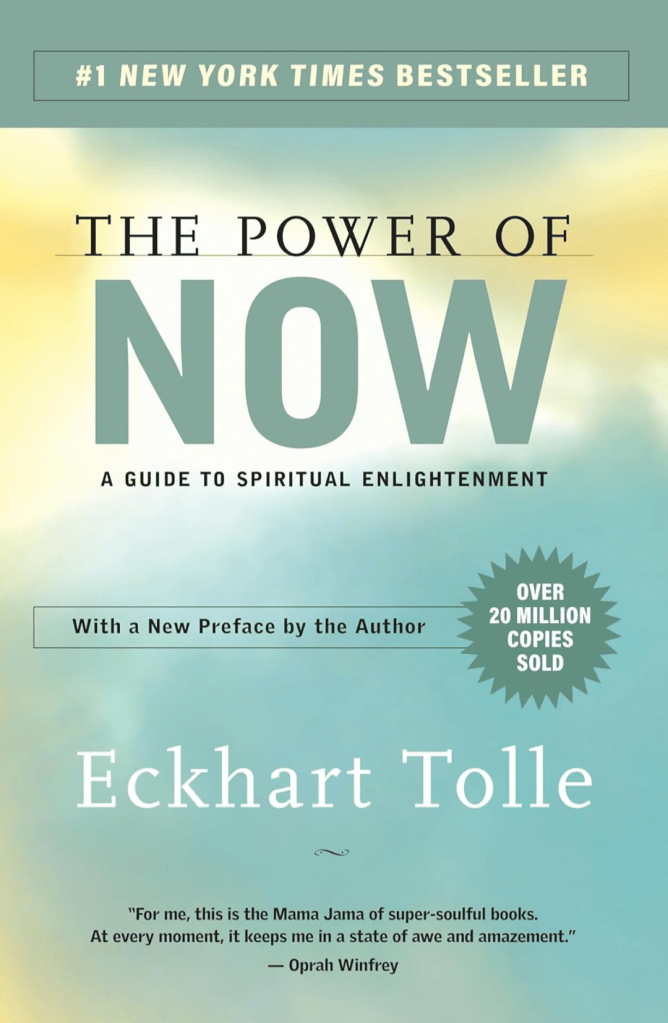
Have you ever noticed how much of your life is spent either replaying the past or worrying about the future? It’s a quiet habit most of us carry—one that often fuels stress, anxiety, and a sense of disconnection. The Power of Now by Eckhart Tolle offers a simple but profound idea: peace is only found in the present moment. This book isn’t just philosophy—it’s an invitation to experience life differently, right now. If you’ve ever felt mentally overwhelmed or stuck in overthinking, this book aims to show you another way.
What The Power of Now Is Really About
At its core, The Power of Now is about shifting your identity away from constant thinking and into awareness.
Tolle argues that:
Most human suffering is created by the mind
We are not our thoughts—we are the observer of them
The present moment is the only place where life actually happens
Rather than presenting a traditional narrative, the book is structured as a series of questions and answers. This makes it feel less like a lecture and more like a guided conversation.
Key Concepts Explained Simply
1. You Are Not Your Mind
One of the book’s most powerful ideas is that your thoughts are not your identity.
Tolle suggests that constantly identifying with your thoughts creates:
Anxiety (future-focused thinking)
Regret (past-focused thinking)
A loss of presence
Instead, he encourages observing thoughts without attaching to them.
This aligns with modern psychology concepts like cognitive defusion—the ability to step back from thoughts rather than be controlled by them.
2. The Present Moment Is All You Ever Have
Tolle emphasizes that:
The past only exists as memory
The future only exists as imagination
The present is the only reality
This isn’t just philosophical—it’s practical.
When you bring attention to the present moment, you often notice:
Reduced stress
Increased clarity
A sense of calm
3. The “Pain-Body” Concept
Tolle introduces the idea of the “pain-body”—a buildup of emotional pain from the past that lives inside you.
It can be triggered by:
Conflict
Stress
Certain relationships
When activated, it can feel like:
Sudden anger
Emotional overwhelm
Irrational reactions
The key, according to Tolle, is awareness. When you notice it, you weaken its control.
4. Acceptance vs Resistance
A major theme in the book is the idea that resistance creates suffering.
Tolle doesn’t mean passive acceptance of everything—but rather:
Accept the present moment as it is
Then act from clarity, not resistance
This subtle shift can dramatically change how you respond to challenges.
What Makes This Book Different
Unlike many self-help books, The Power of Now:
Doesn’t focus on productivity or goals
Doesn’t offer step-by-step systems
Focuses entirely on awareness and consciousness
It’s closer to a spiritual guide than a traditional self-improvement manual.
For some readers, this is deeply transformative. For others, it can feel abstract or repetitive.
Strengths of The Power of Now
Simple but profound ideas that stick with you
Encourages real inner awareness, not just behavior change
Can reduce anxiety when applied consistently
Timeless message that doesn’t rely on trends
Potential Criticisms
To keep things grounded, it’s worth noting:
The writing can feel repetitive
Some concepts are abstract or hard to apply immediately
It leans heavily into spiritual language, which may not resonate with everyone
If you prefer structured, science-based frameworks, this book may feel less concrete.
Practical Takeaways You Can Use Today
You don’t need to fully “master presence” to benefit from this book. Try these simple practices:
1. Pause and Observe
Several times a day, ask:
“What am I thinking right now?”
Just noticing creates distance from the thought.
2. Focus on Sensation
Bring attention to:
Your breath
Your hands
The feeling of walking
This anchors you in the present moment.
3. Accept the Moment (Then Act)
Instead of immediately reacting, try:
“Can I allow this moment to be as it is?”
Then decide what to do next.
4. Reduce Mental Noise
Limit:
Constant phone checking
Multitasking
Background distractions
Silence helps awareness grow.
Who This Book Is Best For
The Power of Now is especially helpful if you:
Struggle with overthinking or anxiety
Feel mentally overwhelmed
Are interested in mindfulness or personal growth
Want a deeper sense of calm and clarity
It may be less appealing if you prefer highly structured, action-based self-help books.
The Power of Now isn’t a quick fix—it’s a perspective shift.
Some readers experience immediate clarity, while others need time to fully grasp its ideas. But at its best, this book gently reveals something most of us overlook: peace isn’t found by fixing your entire life—it’s found by stepping fully into this moment.
And that’s a skill worth practicing.
Call to Action
If this idea resonates with you, explore your own awareness more deeply by reading our [Beginner’s Guide to Mindfulness] or consider starting a simple daily presence practice.
Van life looks romantic from the outside: mountain sunrises, quiet forest roads, coffee by the ocean, and the freedom to wake up somewhere new each morning. But real van life is less about constant adventure and more about learning how to live intentionally in a very small space.
Whether you’re planning weekend road trips or considering a full-time build in a van like the Ram ProMaster, the best experiences usually come from preparation, flexibility, and mindset—not expensive gear.
The good news is that van life can be deeply rewarding when approached thoughtfully. These tips focus on comfort, sustainability, mental clarity, and realistic long-term travel.
Start Smaller Than You Think You Need
One of the most common beginner mistakes is overbuilding.
You do not need:
A massive electrical system
A full indoor shower
A luxury kitchen
Endless storage bins
You do need:
A comfortable bed
Reliable power basics
Simple food storage
Good airflow
Organization
Many experienced travelers eventually realize simplicity creates freedom. Less equipment means:
Fewer breakdowns
Lower costs
Less clutter
Faster setup
Better fuel efficiency
A clean, functional setup often feels calmer psychologically than a packed “tiny apartment on wheels.”
Prioritize Sleep Above Almost Everything Else
Poor sleep can quietly ruin van life.
Your sleeping setup affects:
Mood
Recovery
Energy
Patience
Driving safety
Invest in:
A quality mattress
Ventilation fans
Window covers
Earplugs for noisy areas
Warm blankets for temperature swings
Temperature management matters more than aesthetics. Even beautiful vans become miserable if they trap heat or moisture.
Good airflow is essential, especially in humid climates.
Learn to Travel Slower
Many people try to see too much too quickly.
Van life becomes far more enjoyable when you:
Stay longer in each location
Drive less frequently
Build routines
Explore deeply instead of constantly moving
Slow travel reduces:
Fuel costs
Stress
Vehicle wear
Decision fatigue
It also allows you to actually experience places instead of racing through them.
Some of the best van life days are surprisingly ordinary:
Reading near a lake
Cooking outside
Walking local trails
Visiting small cafés
Practicing music or journaling
Freedom often feels quieter than social media suggests.
Build Around Your Real Lifestyle
A van should support your life—not become your entire identity.
Think honestly about your actual habits:
Do you cook often?
Do you need workspace?
Are you active outdoors daily?
Do you value stealth city parking or nature camping?
Will you teach, work remotely, or perform music?
For example:
Musicians may prioritize instrument storage
Remote workers need stronger power systems
Fitness-focused travelers may want outdoor gear space
Nature-focused travelers may prefer simpler off-grid setups
The best van setups reflect real behavior, not influencer trends.
Keep Daily Organization Extremely Simple
Small messes become big stress quickly in van life.
Use:
Soft storage cubes
Multi-purpose gear
Hooks and vertical storage
One-minute cleanup habits
A simple rule helps:
Everything needs a dedicated home.
Mental clarity and physical organization are deeply connected in small living environments.
Respect Weather and Seasons
Weather affects van life more than most beginners expect.
Summer:
Heat buildup can become dangerous
Direct sun drains energy
Crowded tourist areas fill quickly
Winter:
Condensation increases
Roads become harder
Heating costs rise
Many experienced travelers follow moderate climates rather than chasing extremes.
Learn Basic Vehicle Maintenance
Start simple instead of overbuilding
Focus heavily on sleep quality and ventilation
Travel slower for less stress and deeper experiences
You do not need to become a mechanic. But understanding the basics helps you avoid panic and expensive mistakes.
For long trips, roadside assistance memberships are worth considering.
Have Multiple Parking Options
Never rely on a single overnight plan.
Good van travelers usually keep backup options:
Campgrounds
Public lands
Rest stops
Overnight-friendly businesses
Paid parking apps
Arriving before dark reduces stress significantly.
Apps and communities can help, but local awareness matters most:
Be respectful
Stay quiet
Leave no trace
Avoid overcrowding sensitive areas
Take Care of Your Mental Health on the Road
Van life can feel peaceful—but it can also feel isolating.
Long-term travelers sometimes struggle with:
Loneliness
Lack of routine
Social disconnection
Constant decision-making
Healthy routines help:
Morning walks
Journaling
Reading
Exercise
Creative hobbies
Consistent sleep schedules
If you enjoy music, photography, writing, or nature study, van life can become an incredibly meaningful creative environment.
Budget More Than You Expect
Van life is usually cheaper than traditional living—but not always.
Major costs include:
Fuel
Repairs
Insurance
Campsites
Food
Internet
Maintenance
Unexpected repairs can happen at any time.
A strong emergency fund makes van life far less stressful.
Many experienced travelers recommend:
Keeping monthly fixed costs low
Avoiding unnecessary debt
Maintaining repair savings
Financial flexibility creates travel flexibility.
Nature Becomes More Meaningful When You Slow Down
One of the greatest gifts of van life is renewed attention.
When you spend more time outdoors, you begin noticing:
Seasonal changes
Birdsong
Weather patterns
Sunrise timing
Quiet moments most people rush past
This shift can feel deeply restorative psychologically.
Research in environmental psychology consistently shows that time in nature helps reduce stress, improve attention, and support emotional well-being.
Van life works best when it becomes less about escape and more about reconnection.
Practical Takeaways
Final Thoughts
Van life is not really about the van.
It’s about attention:
How you spend your time
What you truly need
How much space your mind requires
Whether your lifestyle supports your values
For some people, van travel becomes a temporary adventure. For others, it becomes a long-term shift toward simplicity, mobility, and intentional living.
Either way, the most rewarding journeys are usually the ones that leave enough room to actually experience life along the way.
Discover how music affects the brain, emotions, memory, and creativity—and why listening or playing music can improve mental well-being and focus.
You’ve probably felt it before. A song comes on, and suddenly you’re transported to another moment in your life. Maybe it reminds you of a summer drive, a difficult breakup, or a childhood memory you hadn’t thought about in years. Music has a unique power over the human mind—one that scientists, psychologists, and musicians are still trying to fully understand.
But music is more than entertainment. Research increasingly shows that music changes the brain in measurable ways. It can improve memory, reduce stress, strengthen emotional resilience, and even reshape neural pathways over time.
Whether you’re a lifelong musician or someone who simply listens on the way to work, understanding the connection between music and the brain can deepen your appreciation for one of humanity’s oldest art forms.
Why Music Affects Us So Deeply
Unlike many activities that activate one area of the brain, music engages multiple systems simultaneously.
When you listen to music, your brain processes:
Rhythm
Melody
Harmony
Emotion
Memory
Pattern recognition
Prediction
Movement
This widespread activation is one reason music feels so immersive. It’s not just heard—it’s experienced throughout the body and mind.
Neuroscientists have found that music activates regions connected to:
Emotional regulation
Reward and pleasure
Motor coordination
Language processing
Attention
Long-term memory
In some ways, music acts like a full-brain workout.
The Emotional Power of Music
One of music’s most fascinating effects is its ability to influence emotion almost instantly.
A slow piano melody can calm the nervous system. A fast drumbeat can energize the body. A familiar song can trigger nostalgia so intensely that it feels physical.
This happens partly because music interacts with the brain’s dopamine system—the same reward network involved in motivation, pleasure, and anticipation.
Music also helps people process difficult emotions safely. Many people use music to:
Cope with grief
Manage anxiety
Process heartbreak
Improve mood
Regulate stress
This emotional processing is one reason music therapy has become increasingly respected in hospitals, mental health settings, and rehabilitation programs.
Music and Memory
Music’s connection to memory is extraordinary.
People with dementia or Alzheimer’s disease may struggle to remember names or recent conversations, yet still recall songs from decades earlier. Music often accesses emotional and autobiographical memories that remain deeply stored in the brain.
Researchers believe this happens because musical memories are distributed across multiple neural networks rather than stored in a single location.
Music can also improve learning and retention by:
Increasing attention
Enhancing emotional engagement
Creating rhythmic structure
Supporting repetition
This is why children often learn the alphabet through song before they can memorize it through speech alone.
Learning Music Changes the Brain
Listening to music is powerful—but learning music may have even greater neurological benefits.
Studies show that musicians often develop stronger connections between the brain’s hemispheres due to the coordination required between:
Hearing
Movement
Timing
Reading
Memory
Emotional interpretation
Learning an instrument also trains delayed gratification and deep focus in a world increasingly filled with distraction.
Over time, musical practice strengthens skills that transfer into everyday life:
Pattern Recognition
Music trains the brain to recognize structure and relationships.
Attention Control
Playing an instrument requires sustained concentration.
Emotional Awareness
Musicians learn to communicate feeling nonverbally.
Neuroplasticity
Repeated practice strengthens neural pathways and adaptability.
This is one reason music education remains so valuable—not because every student becomes a professional musician, but because music develops the mind itself.
Rhythm and the Human Body
Humans are naturally rhythmic creatures.
Your:
Heartbeat
Breathing
Walking pace
Sleep cycles
—all follow rhythmic patterns.
Music interacts directly with these systems.
Fast rhythms can increase alertness and movement. Slow rhythms may help calm breathing and reduce tension. This phenomenon, known as entrainment, explains why certain music can support exercise, meditation, or sleep.
Drumming traditions across cultures may also reflect music’s social and biological role in synchronizing groups emotionally and physically.
When people sing or move together, feelings of connection often increase.
Music, Creativity, and Meaning
Music also provides something harder to measure scientifically: meaning.
For many people, music becomes:
A form of identity
A spiritual experience
A creative outlet
A source of belonging
Psychologist Carl Jung believed symbolic and emotional expression were essential parts of psychological health. Music often reaches layers of human experience that language alone cannot fully capture.
This may explain why music remains central to nearly every culture in human history.
Even in the modern world of algorithms and productivity, music still gives people moments of transcendence, reflection, and emotional honesty.
Can Music Improve Mental Health?
Music is not a cure-all, but it can meaningfully support mental well-being when used intentionally.
Healthy musical habits may include:
Active Listening
Instead of passive background noise, sit and fully engage with an album or composition.
Learning an Instrument
Even beginner practice improves attention and cognitive flexibility.
Singing
Singing regulates breathing and may reduce stress hormones.
Nature + Music
Listening to calming instrumental music during walks or hikes can deepen relaxation.
Reducing Overstimulation
Not all music is calming. Constant high-intensity audio input can increase mental fatigue for some people.
The key is awareness. Music shapes emotional states more than many people realize.
Practical Takeaways
If you want to use music more intentionally in daily life:
Create playlists for different mental states (focus, relaxation, exercise, reflection)
Spend time listening without multitasking
Learn basic music skills—even simple rhythm exercises help
Use instrumental music during deep work
Protect quiet moments too; the brain also needs silence
Explore unfamiliar genres to stimulate curiosity and creativity
You don’t need to be a professional musician to benefit from music deeply.
Final Thoughts
Music is one of the few human experiences that connects emotion, memory, movement, creativity, and meaning all at once.
It can energize us, comfort us, challenge us, and reconnect us with forgotten parts of ourselves.
In a distracted and fast-moving world, music offers something increasingly rare: sustained attention and emotional presence.
Perhaps that’s why humans have carried music with them for thousands of years. Not simply because it sounds good—but because it helps us feel fully alive.
Learn how to build a balanced breakfast for sustained muscle growth, steady energy, and recovery using simple, protein-rich whole foods.
You can train hard, hit your protein goals, and still feel like something is missing. Often, the problem is not effort — it is timing and balance. A strong breakfast does more than “start your day.” It signals recovery, stabilizes energy, supports hormone function, and gives your muscles the nutrients they need after an overnight fast.
For people focused on lean muscle growth, strength, and long-term health, breakfast becomes especially important. The goal is not just calories. It is creating a meal that combines protein, healthy fats, complex carbohydrates, and micronutrients in a way your body can actually use.
A balanced breakfast can improve:
Workout performance
Recovery
Focus and mood
Appetite control later in the day
Consistency with nutrition goals
The good news is that it does not need to be complicated.
Why Breakfast Matters for Muscle Growth
After sleeping, your body has gone hours without protein intake. Muscle protein synthesis — the process that repairs and builds muscle tissue — benefits from receiving high-quality protein early in the day.
Research also suggests that spreading protein intake throughout the day may support muscle growth more effectively than eating most of it at dinner.
A strong breakfast helps:
Reduce muscle breakdown
Replenish energy stores
Support stable blood sugar
Improve training readiness
For active adults, aiming for roughly 25–40 grams of protein at breakfast is often a practical target.
The Four Components of a Muscle-Building Breakfast
1. High-Quality Protein
Protein is the foundation.
Good breakfast protein sources include:
Eggs
Greek yogurt
Cottage cheese
Smoked salmon
Chicken sausage
Protein smoothies
Tofu or tempeh
Protein oats
Protein provides amino acids, especially leucine, which helps trigger muscle repair and growth.
2. Complex Carbohydrates
Carbs are not the enemy of a lean physique. In fact, they help fuel performance and recovery.
Good options include:
Oats
Ezekiel bread
Whole grain toast
Sweet potatoes
Berries
Bananas
Complex carbs provide steady energy rather than a quick spike and crash.
3. Healthy Fats
Healthy fats help with:
Hormone production
Satiety
Brain function
Joint health
Good sources:
Avocado
Natural peanut butter
Nuts and seeds
Olive oil
Chia seeds
4. Micronutrients and Fiber
Muscle growth is not just about protein. Vitamins, minerals, hydration, and digestion all matter.
Add:
Berries
Spinach
Tomatoes
Kale
Citrus
Seeds
These support recovery, immunity, and long-term health.
If you enjoy practical wellness and performance articles grounded in psychology and long-term health, consider giving this a like and subscribing to the Mindful Explorer newsletter.
Discover 10 science-backed reasons why quality sleep improves health, focus, mood, and longevity—and how to start sleeping better tonight.
You already know sleep matters—but most people still treat it like it’s optional. Late nights, screens, stress, and inconsistent routines quietly erode something essential: your ability to think clearly, feel balanced, and function at your best.
If you’ve ever felt foggy, irritable, or unmotivated, poor sleep may be the hidden cause. The truth is, quality sleep isn’t just rest—it’s active restoration for your brain and body.
In this article, we’ll explore 10 powerful reasons why sleep is one of the most important habits you can build—and how it affects nearly every part of your life.
1. Sleep Strengthens Brain Function
During sleep, your brain processes information, consolidates memories, and clears out metabolic waste.
Without enough quality sleep:
Focus declines Reaction time slows Learning becomes harder
Think of sleep as your brain’s nightly reset.
2. It Regulates Mood and Emotional Stability
Sleep deprivation is closely linked to anxiety and irritability.
When you’re well-rested:
You respond instead of react Emotional resilience improves Stress feels more manageable
Even one poor night can amplify negative emotions.
3. Sleep Supports Physical Recovery
Your body repairs muscle tissue, releases growth hormone, and reduces inflammation while you sleep.
This is especially important if you:
Exercise regularly Lift weights Are recovering from injury
No recovery = no progress.
4. It Improves Immune Function
Consistent, quality sleep strengthens your immune system.
Poor sleep is associated with:
Increased risk of illness Slower recovery Higher inflammation
In simple terms: sleep helps your body fight back.
5. Sleep Enhances Memory and Learning
Your brain organizes and stores new information during deep sleep cycles.
Students, musicians, and professionals benefit from:
Sleep regulates hormones like ghrelin (hunger) and leptin (fullness).
When sleep is lacking:
Cravings increase (especially for sugar) Appetite rises Metabolism becomes less efficient
This is why poor sleep often leads to overeating.
7. Sleep Supports Heart Health
Chronic sleep deprivation is linked to:
High blood pressure Increased heart disease risk Elevated stress hormones
Your cardiovascular system needs rest just as much as your muscles do.
8. It Improves Focus and Productivity
After a good night’s sleep:
You think more clearly You make better decisions You complete tasks faster
Sleep is one of the most underrated productivity tools.
9. Sleep Promotes Longevity
Long-term sleep quality is associated with a longer, healthier life.
Poor sleep patterns over time can increase risk of:
Chronic disease Cognitive decline Early mortality
Sleep is an investment in your future self.
10. It Supports Creativity and Problem-Solving
During REM sleep, your brain makes new connections between ideas.
This leads to:
Creative breakthroughs Improved problem-solving Better insight and intuition
Many “aha” moments come after rest—not effort.
Practical Takeaways: How to Improve Your Sleep
Here are simple, research-backed steps you can start tonight:
Keep a consistent sleep schedule (even on weekends) Limit screen time 60 minutes before bed Create a cool, dark sleeping environment Avoid caffeine 6–8 hours before sleep Try a wind-down routine (reading, stretching, breathing) Get morning sunlight to regulate your internal clock
Consistency matters more than perfection.
If you found this helpful, consider exploring more practical wellness insights on Mindful Explorer
Discover the science-backed benefits of gratitude and how a simple daily practice can improve your mood, relationships, and overall well-being.
What if one of the most powerful tools for improving your mental health, relationships, and daily happiness was already available to you—right now?
Gratitude often sounds simple, even cliché. But beneath that simplicity lies something deeply transformative. In a world wired for stress, comparison, and constant striving, gratitude shifts your attention toward what is already meaningful.
This article matters because gratitude isn’t just a “feel-good” idea—it’s a proven psychological practice that can rewire how you experience life.
What Gratitude Really Is (Beyond Saying “Thank You”)
Gratitude is more than politeness. It’s a way of seeing.
At its core, gratitude is the intentional recognition of value—especially in things we usually overlook.
This can include:
A conversation that made you feel understood
Your body carrying you through the day
A quiet moment without distraction
Food, shelter, or safety
Gratitude doesn’t ignore hardship. It expands your awareness so that difficulty isn’t the only thing you notice.
The Psychology Behind Gratitude
From a psychological perspective, gratitude works because it reshapes attention.
Your brain has a built-in negativity bias—it naturally scans for problems, threats, and what’s missing. This helped humans survive, but it can also make modern life feel constantly insufficient.
Gratitude interrupts that pattern.
Research in positive psychology shows that practicing gratitude can:
Increase baseline happiness
Reduce symptoms of anxiety and depression
Improve sleep quality
Strengthen emotional resilience
Why?
Because what you repeatedly focus on becomes your experience. Gratitude gently trains your mind to notice what is working, not just what is broken.
Gratitude and the Nervous System
Gratitude doesn’t just change thoughts—it affects your body.
When you intentionally reflect on something meaningful or appreciated, your nervous system can shift out of stress mode (fight-or-flight) and into a calmer, more regulated state.
This is often associated with:
Slower heart rate
Reduced cortisol (stress hormone)
Increased feelings of safety
In simple terms, gratitude signals: “Right now, there is something okay here.”
That message alone can be powerful.
Why Gratitude Feels Difficult Sometimes
If gratitude is so beneficial, why doesn’t it always come naturally?
Because it can feel forced—especially during stress, loss, or frustration.
Common barriers include:
Comparison: Focusing on what others have
Adaptation: Quickly getting used to good things
Emotional overwhelm: When problems feel too big
Gratitude is not about denying these realities.
Instead, it’s about holding two truths at once:
Something is difficult
Something is still meaningful
That balance is where real resilience grows.
Simple Ways to Practice Gratitude (That Actually Work)
You don’t need a complicated routine. What matters is consistency and sincerity.
1. The “Three Noticings” Practice
At the end of the day, write or reflect on three things you noticed and appreciated.
They should be specific:
Not “my family”
But “the way we laughed at dinner”
Specificity deepens the emotional impact.
2. Gratitude Walks
Take a walk and intentionally notice things you usually ignore:
The texture of trees
The rhythm of your steps
The feeling of fresh air
This combines mindfulness with appreciation.
3. Express It to Someone
Tell someone what you appreciate about them—clearly and directly.
This not only strengthens relationships but reinforces your own sense of connection.
4. Reframing Challenges
Ask yourself:
“Is there anything in this situation that is helping me grow, learn, or pause?”
This isn’t about forcing positivity—it’s about widening perspective.
The Long-Term Impact of Gratitude
Over time, gratitude becomes less of a practice and more of a lens.
You may begin to notice:
More patience in stressful situations
Greater satisfaction with everyday life
Stronger relationships
A quieter, steadier mind
Life doesn’t suddenly become perfect.
But your relationship to life changes—and that makes all the difference.
Practical Takeaways
Gratitude is a skill, not a personality trait
It works by shifting attention, not denying reality
Small, consistent practices are more effective than big gestures
Specificity makes gratitude more powerful
It supports both mental and physical well-being
If this resonated with you, consider building a small daily gratitude practice this week—and notice what changes.
Or explore our deeper guide on mindfulness to strengthen your awareness even further.
Discover the meaning of Earth Day, why it matters, and simple ways you can make a real impact starting today.
You don’t need to be a scientist, activist, or politician to care about the Earth—you just need to live here. And you do.
Earth Day is more than a date on the calendar—it’s a reminder that small, everyday choices shape the future of the planet. Whether it’s the air you breathe, the water you drink, or the parks you walk through, your life is deeply connected to the natural world.
This article isn’t about guilt or overwhelming responsibility. It’s about understanding Earth Day—and discovering realistic, meaningful ways you can make a difference.
🌱 What Is Earth Day?
Earth Day is celebrated every year on April 22. It began in 1970 as a response to growing environmental concerns like pollution, oil spills, and habitat destruction.
What started as a grassroots movement has grown into a global event involving over 190 countries.
At its core, Earth Day is about:
Raising awareness about environmental issues
Encouraging sustainable habits
Inspiring collective action
🌿 Why Earth Day Still Matters
1. We’re More Connected to Nature Than We Think
Even if you live in a city, your well-being depends on ecosystems working behind the scenes:
Clean air from forests
Food from soil and pollinators
Water from natural cycles
When these systems are stressed, we feel it—physically and mentally.
2. Environmental Change Is Already Happening
Climate shifts, biodiversity loss, and pollution aren’t distant problems—they’re current realities.
But here’s the important part: Human behavior caused much of this—and human behavior can improve it.
3. Small Actions Scale Over Time
One person using less plastic won’t change the world overnight.
But millions of people making slightly better choices? That’s how real change happens.
🌎 Simple Ways to Celebrate Earth Day
You don’t need to overhaul your life. Start with one or two of these:
🌳 Get Outside (and Notice More)
Take a walk in a local park
Leave your phone in your pocket for part of it
Pay attention to sounds, textures, and patterns
This builds something powerful: connection → care → action
♻️ Reduce One Source of Waste
Pick one area and improve it:
Switch to reusable grocery bags
Use a refillable water bottle
Cut down on single-use plastics
🚲 Rethink One Habit
Ask yourself:
“What’s one thing I do daily that could be slightly more sustainable?”
Examples:
Drive less for short trips
Eat one plant-based meal
Turn off unused lights
🌱 Plant Something
Even a small act like planting herbs or flowers:
Supports pollinators
Improves local ecosystems
Creates a deeper sense of responsibility
🧠 The Psychology of Caring for the Earth
People don’t protect what they feel disconnected from.
Research in psychology shows that:
Time in nature reduces stress and improves mood
Feeling connected to nature increases pro-environmental behavior
Small wins build lasting habits
This means Earth Day isn’t just about the planet— it’s also about your mental well-being.
🌍 Practical Takeaways
Start small: choose one sustainable habit this week
Spend intentional time outdoors—even 10 minutes matters
Replace one disposable item with a reusable option
Learn something new about your local environment
Talk about it—awareness spreads through conversation
🌿 Final Thought
Earth Day isn’t about being perfect—it’s about being aware.
The goal isn’t to live a zero-impact life overnight. It’s to gradually shift toward a life that respects the systems that sustain you.
And that shift starts with noticing… and choosing differently.