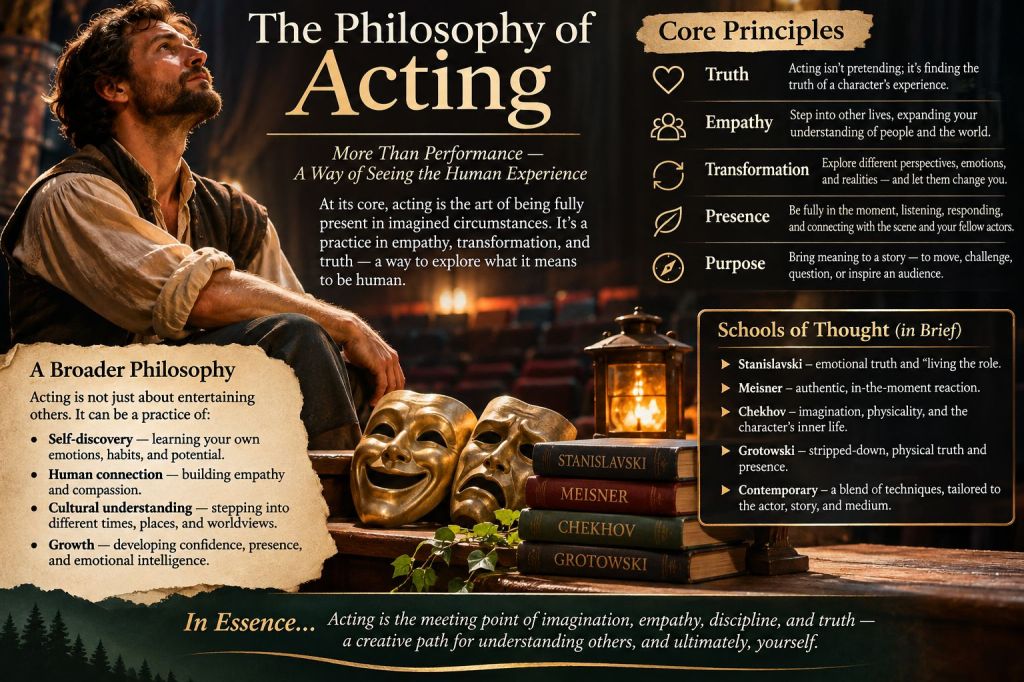
What if pretending to be someone else could help you better understand who you really are?
At first glance, acting seems like an exercise in deception. An actor assumes another identity, speaks words someone else has written, and experiences emotions within circumstances that may never have happened.
Yet great acting often feels more truthful than ordinary conversation.
This paradox lies at the heart of the philosophy of acting. Far beyond entertainment, acting explores human identity, emotional experience, empathy, and the relationship between authenticity and performance.
Whether you dream of stepping onto a stage or simply want to understand human behavior more deeply, the principles behind acting offer valuable lessons about how we experience life.
What Is the Philosophy of Acting?
The philosophy of acting examines a deceptively simple question: What does it mean to become another person while remaining yourself?
An actor must balance two realities. One is the fictional world of the character. The other is the actor’s actual identity, awareness, and responsibility.
The performance exists somewhere between them.
Consider an actor portraying someone who has just lost a loved one. The actor has not necessarily experienced that particular loss, yet must communicate the character’s grief in a believable way.
Is the emotion real? Is the performance artificial? Or can something be emotionally authentic even when its circumstances are imaginary?
These questions connect acting to philosophy, psychology, and the study of consciousness.
They also invite us to reconsider the roles we play outside the theater.
Aristotle: Acting as a Reflection of Human Nature
The philosophical exploration of theater stretches back thousands of years.
In ancient Greece, Aristotle described drama through the concept of mimesis, often translated as imitation or representation.
But imitation, in Aristotle’s understanding, was more than simply copying reality.
Drama could represent human actions, choices, motivations, and the consequences that follow.
A tragedy might explore jealousy, ambition, loyalty, or pride. Audiences could recognize these qualities even when the characters and events were fictional.
Aristotle also introduced the concept of catharsis, associated with the emotions of pity and fear. Scholars continue to debate precisely what he intended by the term, but his broader philosophy recognizes drama’s capacity to engage both emotion and understanding. Stanford Encyclopedia of Philosophy+1
Why This Matters Today
When we watch a compelling performance, we are not simply observing another person’s problems.
We are exploring possibilities within human nature.
A character driven by jealousy might reveal our own insecurities. A courageous character might inspire us to consider how we would respond under similar circumstances.
Theater becomes a place where we can examine human choices without having to experience every consequence ourselves.
Stanislavski: Finding Truth Within Imaginary Circumstances
One of the most influential figures in modern acting was Konstantin Stanislavski.
Stanislavski believed that believable acting required more than memorizing lines or reproducing exaggerated emotional expressions.
Actors needed to understand the internal logic of their characters.
His approach included an exercise known as the Magic If.
Instead of asking, “How should I pretend to feel?” the actor asks:
“What would I do if I were living under these circumstances?”
This subtle shift changes the entire approach to performance.
Rather than manufacturing emotion, the actor explores the character’s situation, objectives, obstacles, and relationships.
Understanding the Character’s Motivation
Imagine playing a character who is angry with a close friend.
A superficial performance might involve raising your voice and appearing frustrated.
A more thoughtful performance asks deeper questions:
- What does this character want from the friend?
- What is the character afraid of losing?
- What happened before the conversation began?
- Is the anger concealing sadness, embarrassment, or fear?
Stanislavski’s approach emphasizes the relationship between circumstances, intentions, and believable behavior. processes developed by Stanislavski
This has an important application beyond acting.
In everyday life, we often judge another person’s behavior without understanding the motivations behind it.
Acting encourages us to become curious about those hidden motivations.
The person who appears arrogant may actually be insecure. Someone who seems distant may be protecting themselves from rejection.
Understanding does not require agreement, but it can replace simplistic judgments with a more complete picture of human behavior.
Sanford Meisner: Acting as the Art of Being Present

If Stanislavski emphasized understanding the character, Sanford Meisner placed particular importance on truthful behavior in the present moment.
Meisner believed that actors could become so concerned with how they appeared that they stopped genuinely responding to their surroundings.
Instead of listening to their scene partners, they anticipated their next lines or planned their emotional reactions.
The result might look polished but feel lifeless.
Meisner’s training emphasized listening, observing, and responding spontaneously to another person’s behavior. tisch.nyu.edu
The Difference Between Performing and Responding
Consider two actors having an argument.
The first actor decides beforehand exactly when to become angry, when to look away, and when to raise their voice.
The second actor understands the character’s objective but allows the scene partner’s words and behavior to influence each response.
The second performance has greater potential to feel alive because the actor is participating in the moment rather than merely demonstrating a rehearsed emotion.
This resembles an important principle in mindfulness: paying attention to what is actually happening instead of becoming lost in internal commentary.
We frequently do the same thing in ordinary conversations.
We rehearse our responses, anticipate criticism, or worry about how we are being perceived.
Acting reminds us that genuine connection requires attention.
The Paradox of Authenticity: Are We All Actors?

One of the most fascinating philosophical questions raised by acting concerns personal identity.
Are we fundamentally the same person in every situation?
Think about how you behave when speaking with a close friend, attending a job interview, teaching a class, or meeting someone for the first time.
Your language, posture, facial expressions, and emotional openness probably change.
Does that make you inauthentic?
Not necessarily.
Social psychologist Erving Goffman famously explored social interaction using theatrical metaphors in his book The Presentation of Self in Everyday Life.
His work suggests that people manage how they present themselves depending on their audience, circumstances, and social expectations.
We do not necessarily have one rigid identity that appears identically in every setting.
Instead, our personalities contain multiple possibilities.
Acting Reveals the Flexibility of Identity
Consider a naturally reserved person learning to portray a confident leader.
The actor may need to experiment with behaviors that feel unfamiliar:
- Standing with greater physical openness.
- Speaking clearly and decisively.
- Maintaining eye contact.
- Expressing opinions without immediately apologizing.
Over time, these behaviors may become easier to access.
The actor has not necessarily become a different person. Rather, the experience may reveal capacities that were previously underused.
This is one reason acting can be personally meaningful even for someone with no intention of pursuing a professional career.
It creates a structured opportunity to explore different ways of being.
Can Acting Make Us More Empathetic?
Empathy involves recognizing or understanding another person’s emotional experience.
Actors routinely practice imagining the world from perspectives that differ from their own.
To portray a character convincingly, an actor often needs to understand why that person thinks and behaves as they do.
Even a morally troubling character must have motivations that make sense within the story.
This does not mean excusing harmful behavior.
It means understanding the psychological processes that produce it.
What Psychology Tells Us
Research offers some support for the relationship between dramatic storytelling and empathy.
A 2021 study published in the Journal of Experimental Social Psychology examined audience responses to live theater across three field studies involving 1,622 participants.
Researchers found that watching live theater was associated with increased empathy, changes in attitudes, and greater charitable behavior in the studied settings. ScienceDirect
However, this research focused on theater audiences rather than proving that acting training itself makes people more empathetic.
The distinction matters.
Acting may provide valuable opportunities to practice perspective-taking, but its psychological benefits depend on the individual, the training environment, and the nature of the experience.
The broader lesson remains compelling: stories can help us engage with experiences outside our own lives.
Bertolt Brecht: Should Acting Make Us Feel or Think?
Not every philosophy of acting prioritizes emotional immersion.
German playwright and theorist Bertolt Brecht developed an approach commonly associated with epic theater.
Brecht challenged the idea that audiences should become so absorbed in a performance that they forget they are watching a play.
He used techniques that encouraged viewers to maintain a critical distance from the action.
Actors might directly address the audience, narrate events, or deliberately reveal the constructed nature of a scene.
The purpose was not simply to eliminate emotion. It was to encourage audiences to question the social circumstances shaping the characters’ lives. The Edinburgh Dictionary of Modernism
Two Different Paths Toward Truth
Stanislavski and Brecht represent contrasting approaches that can both reveal something important about human experience.
Stanislavski asks us to understand what a situation feels like from within.
Brecht encourages us to examine the situation from outside.
One emphasizes psychological immersion. The other creates space for critical reflection.
Both approaches have value.
In everyday life, we also benefit from balancing emotional understanding with thoughtful distance.
Sometimes we need to enter another person’s perspective.
At other times, we need enough separation to question the assumptions behind a situation.
Acting, Vulnerability, and the Courage to Be Seen
Acting requires an unusual willingness to be observed.
A performer may have to express fear, affection, embarrassment, joy, or grief in front of complete strangers.
For many people, that kind of visibility feels uncomfortable.
Much of our everyday behavior involves managing how others perceive us. We conceal uncertainty, avoid embarrassment, and attempt to appear competent.
Acting can challenge these habits.
An actor may need to look foolish, lose an argument, make a mistake, or expose a character’s deepest insecurity.
These experiences can gradually make public expression feel less threatening.
But emotional vulnerability does not require abandoning personal boundaries.
An actor does not need to relive trauma or experience genuine psychological distress to deliver a convincing performance.
Imagination, observation, physical action, and technical skill can create compelling performances without sacrificing emotional well-being.
Good acting is not measured by how much an actor suffers.
It is measured by how effectively the performance communicates the character’s experience.
Acting as a Form of Mindfulness
Acting and mindfulness share several important qualities.
Both encourage awareness of the present moment, attention to subtle changes, and a willingness to notice experience without immediately controlling it.
An actor must remain aware of the scene partner, the environment, physical movement, and the unfolding emotional situation.
At the same time, excessive self-monitoring can interrupt the performance.
This creates an interesting tension.
The actor must be highly attentive without becoming excessively self-conscious.
Similar challenges appear in music, sports, and everyday conversation.
A musician who thinks about every finger movement may struggle to play naturally. An athlete who consciously controls every step may lose coordination.
With sufficient preparation, complex skills can become more fluid, allowing attention to shift toward the larger experience.
For actors, this may mean moving beyond memorized lines and toward genuine interaction.
For everyday life, it suggests that preparation and presence are not opposites. They can support each other.
Practical Acting Exercises for Everyday Life
You do not need a theater degree or professional acting ambitions to begin exploring these ideas.
The following exercises can develop observation, imagination, and awareness.
1. Practice the Magic If
Choose an ordinary fictional situation.
Imagine that you have unexpectedly encountered an old friend who disappeared from your life ten years ago.
Ask yourself what you would want, what you might fear, and what you would do first.
Avoid planning an emotional performance.
Focus instead on how the imagined circumstances might influence your behavior.
2. Practice Active Listening
Have a conversation with a trusted friend and deliberately shift your attention away from your own planned responses.
Notice changes in their voice, pauses, facial expressions, and body language.
Listen to understand rather than simply waiting for your turn to speak.
Afterward, reflect on whether the conversation felt different.
3. Observe Human Behavior
Spend ten minutes in a public setting observing ordinary interactions without staring or intruding.
Notice how people move, respond to one another, and communicate through small gestures.
Separate what you actually observe from the stories you imagine about their motivations.
This distinction is essential for both good acting and thoughtful psychological observation.
4. Explore a Different Character
Choose a short monologue or fictional scene involving someone whose personality differs from yours.
Before performing, identify three things:
- The character’s immediate objective.
- The greatest obstacle preventing that objective.
- The action the character takes to overcome it.
Try the scene several times, allowing your delivery to change as you explore different interpretations.
5. Reflect After the Performance
After each exercise, ask yourself what felt natural, what felt uncomfortable, and what surprised you.
Did the experience reveal a new perspective or an unfamiliar way of expressing yourself?
Reflection turns a simple acting exercise into an opportunity for personal discovery.
The Deeper Meaning of Acting
Perhaps the greatest philosophical insight acting offers is that human identity is more complex than we ordinarily assume.
We are influenced by our histories, relationships, environments, and expectations.
Yet we also possess the capacity to imagine possibilities beyond our familiar habits.
Acting allows us to explore those possibilities within the safety of a fictional world.
It teaches us to observe rather than immediately judge, listen rather than merely respond, and understand behavior through the circumstances that shape it.
And it reveals a curious truth: sometimes, stepping into a fictional identity can help us recognize aspects of ourselves that everyday life rarely brings to the surface.
The purpose of acting is not necessarily to escape who we are.
It may be to discover how much more there is to being human.