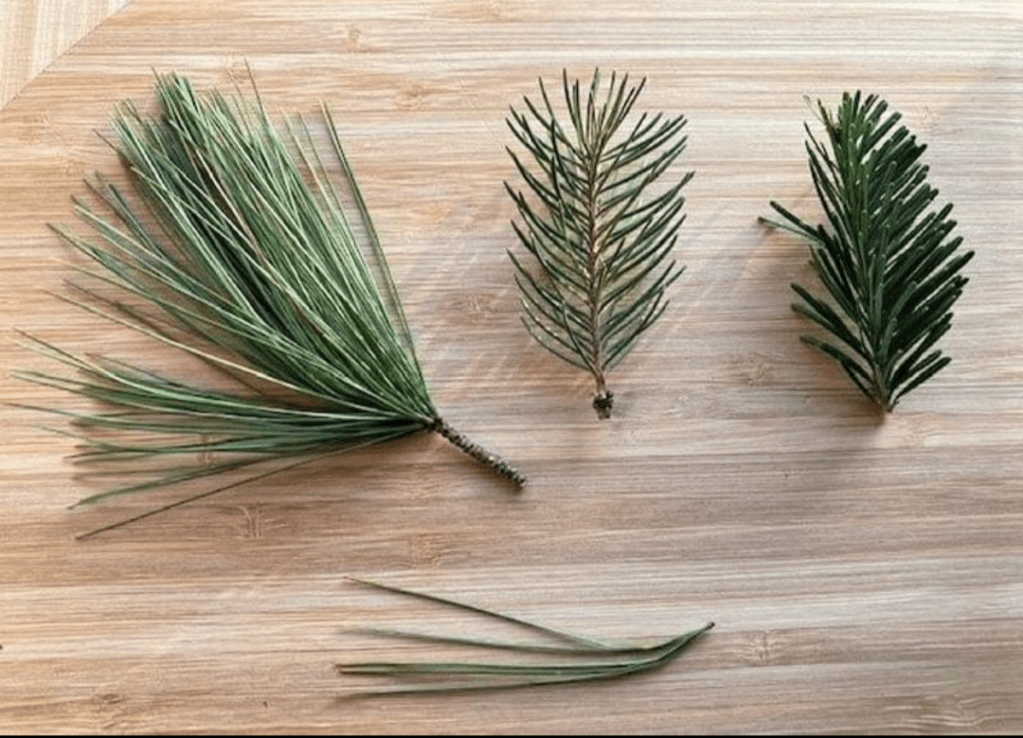
Walk through almost any northern forest or suburban neighborhood and you’ll probably encounter trees you casually call “pine trees.” But many of them aren’t pines at all.
Spruce and pine are both evergreen conifers, and from a distance they can look remarkably similar. Up close, however, they have several characteristics that make identification surprisingly easy.
The best part is that you don’t need to be a botanist. Once you learn to look at the needles—especially how many grow from each attachment point—you can often distinguish a pine from a spruce within seconds. Learning these small details can also make an ordinary walk through the woods feel much more interesting.
Spruce vs. Pine: The Basic Difference
Pines and spruces belong to the same botanical family, Pinaceae, which also includes firs, larches, hemlocks, and cedars of the genus Cedrus.
But they belong to different genera:
- Pine: Pinus
- Spruce: Picea
Both produce cones rather than flowers and fruits in the way broadleaf trees such as maples and oaks do.
Both also usually retain their needles throughout the winter.
The easiest way to distinguish them isn’t their overall shape. It’s their needles.
Pine Needles Grow in Bundles
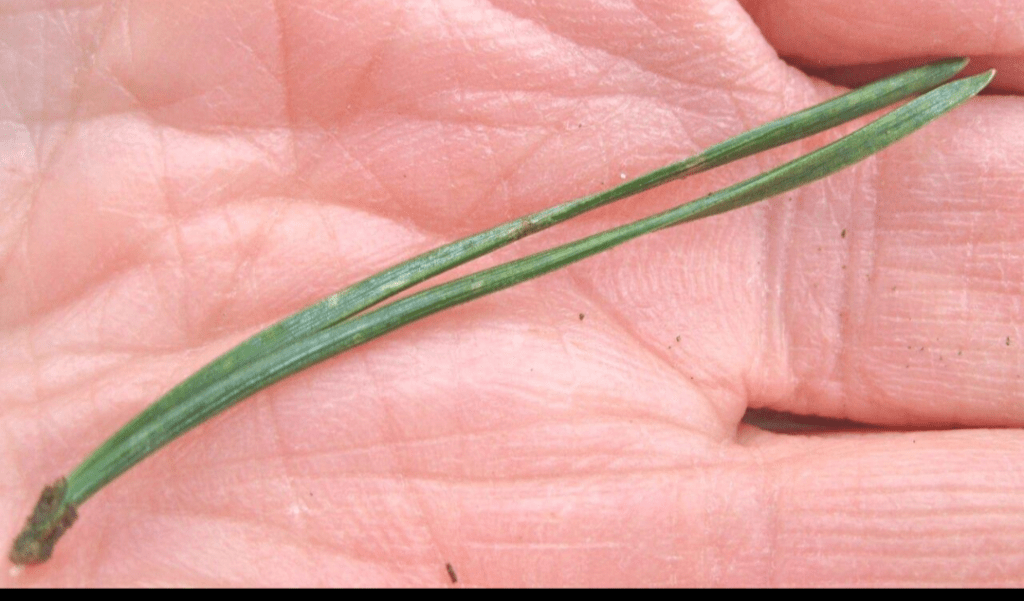
If you remember only one identification trick, remember this:
Pine needles grow in bundles.
These bundles are technically called fascicles.
Depending on the pine species, each fascicle commonly contains two, three, or five needles.
For example:
- Eastern white pine usually has five needles per bundle.
- Scots pine usually has two needles per bundle.
- Red pine usually has two needles per bundle.
- Pitch pine commonly has three needles per bundle.
This makes needle counting an excellent starting point for identifying individual pine species.
Pine needles also tend to be relatively long and flexible compared with spruce needles. Some species have needles several inches long that bend easily between your fingers.
A Simple Pine Memory Trick
Think:
Pine = Packets
If several needles emerge together in a little packet or bundle, you’re probably looking at a pine.
Spruce Needles Grow Individually
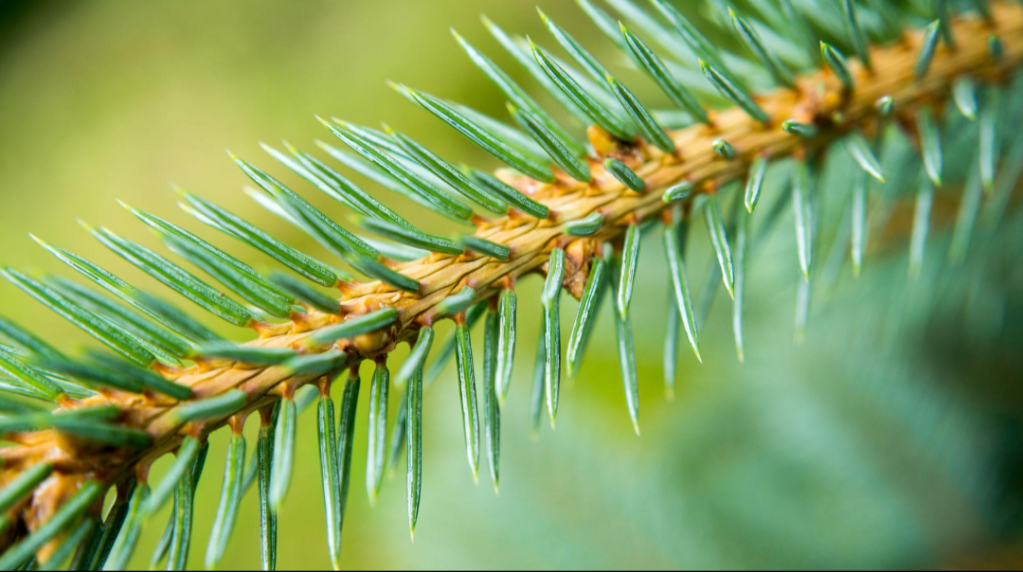
Spruce does something very different.
Instead of growing in bundles, spruce needles attach individually to the branch.
Look closely at a spruce twig and you’ll see one needle emerging from each attachment point.
Spruce needles also tend to be:
- Shorter than many pine needles
- Stiffer
- Pointed
- Somewhat prickly
- Square or four-sided in cross-section
Try gently rolling a spruce needle between your fingers. Many spruce needles roll surprisingly easily because they’re roughly four-sided rather than flat.
They can also feel noticeably sharp when you grab a branch.
A useful memory trick is:
Spruce = Single and Spiky
Single needles plus a prickly texture strongly suggest spruce.
Look at the Branches, Too
The twigs provide another excellent identification clue.
Spruce needles grow from tiny woody projections called sterigmata.
When a spruce needle falls off, the little peg remains behind.
As a result, older spruce twigs often feel noticeably rough or bumpy when you run your fingers over them.
Pine needles don’t leave the same collection of woody pegs.
So if you’re examining an unknown evergreen, look at an older section of twig where some needles have fallen.
A rough, peg-covered twig strongly suggests spruce.
Pine Cones vs. Spruce Cones
Cones provide another useful clue, although their appearance varies considerably among species.
Pine Cones
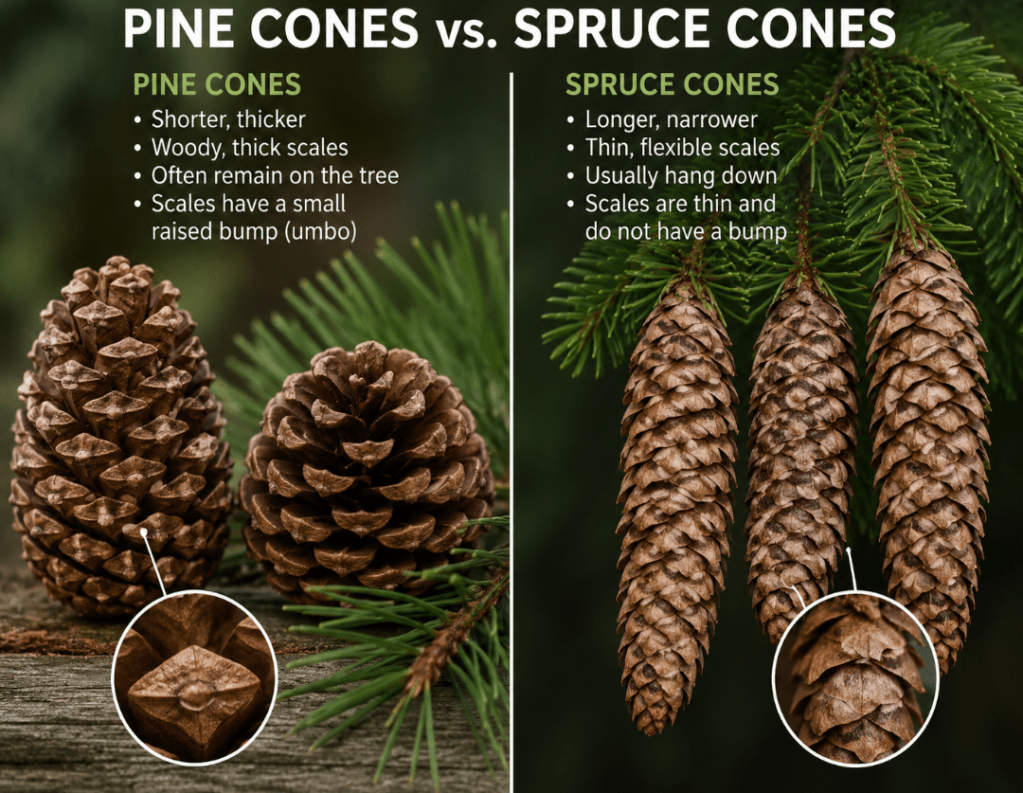
Pine cones often have relatively thick, woody scales.
Depending on the species, they may be:
- Small and rounded
- Long and cylindrical
- Heavily armored with thick scales
- Smooth or somewhat prickly
Some pine cones can remain attached to a tree for years.
Spruce Cones
Spruce cones generally:
- Hang downward from branches
- Have thinner scales
- Feel lighter and more flexible
- Are often elongated or cylindrical
If you find an intact cone beneath the tree, gently squeezing it can sometimes help.
A thick, hard, woody cone suggests pine, while a lighter cone with thinner scales may indicate spruce.
What About the Shape of the Tree?
Tree shape can provide clues, but it isn’t as reliable as examining the needles.
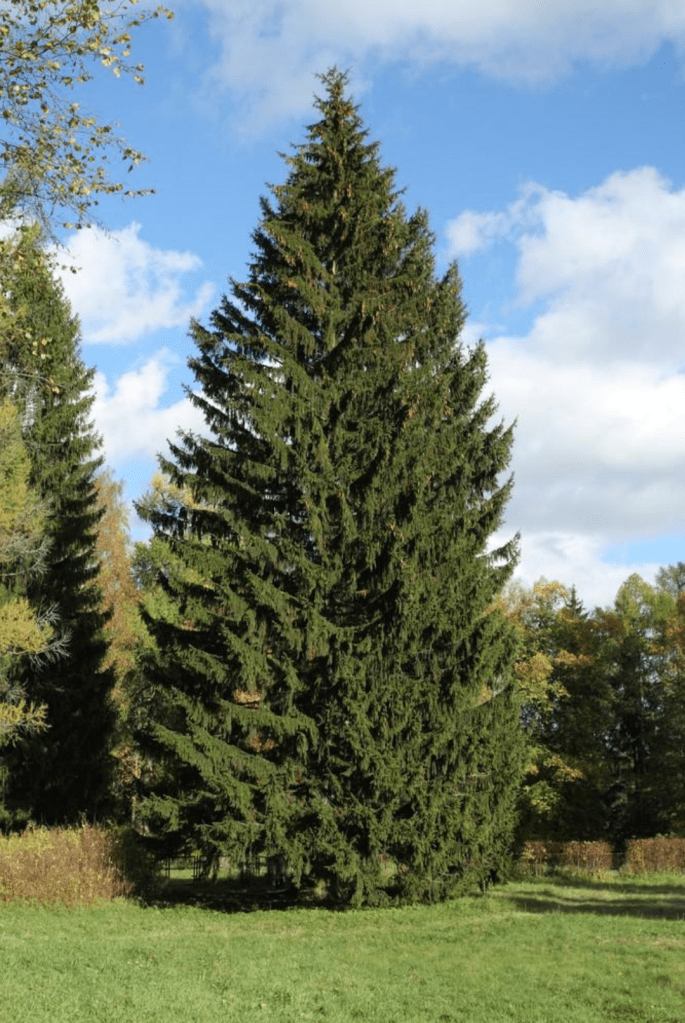
Spruce trees frequently develop the classic Christmas-tree shape—a narrow, symmetrical pyramid with branches arranged around a central trunk.
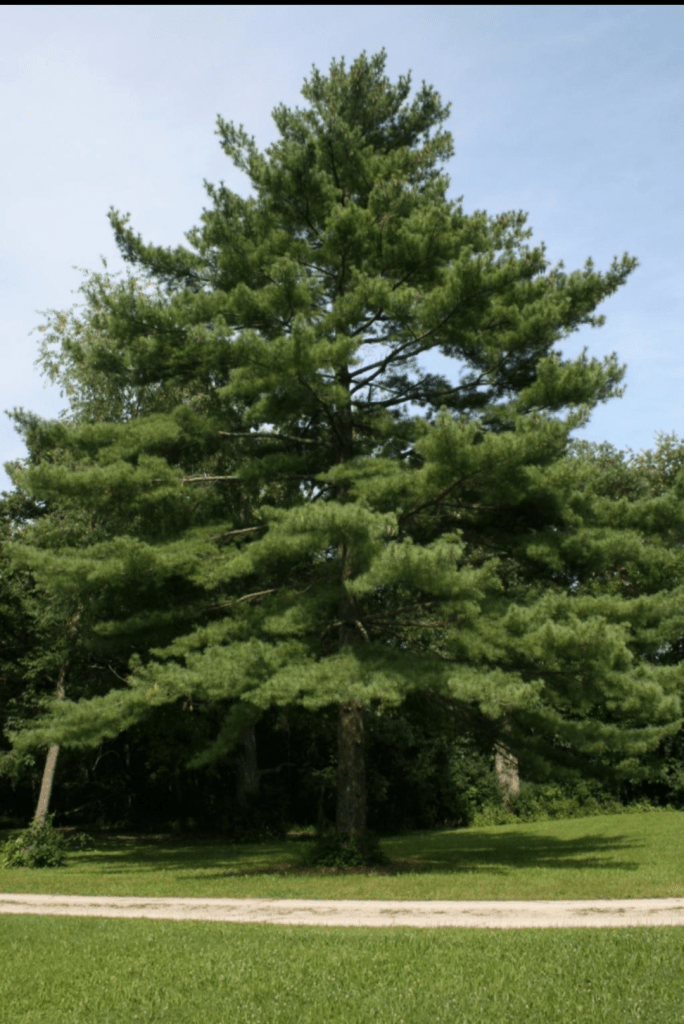
Many pines become less symmetrical as they mature.
Older pines can develop broad crowns, irregular branching, and large open spaces between branches.
But growing conditions dramatically influence tree shape.
Wind, shade, competition, storms, pruning, and available sunlight can all alter a tree’s appearance.
That’s why needles should usually be your first clue.
Spruce vs. Pine Bark
Bark becomes more useful once you start trying to identify individual species.
Young pine trees can have relatively smooth bark, while mature pines often develop thick, scaly, or deeply furrowed bark.
Some species develop particularly distinctive bark.
Scots pine, for example, can develop striking orange or reddish bark toward the upper portion of mature trees.
Spruce bark generally tends to be thinner and more scaly, sometimes breaking into small plates.
However, bark varies substantially with species and age, so it shouldn’t be your only identification method.
Why Learning Tree Identification Is Worthwhile
Knowing the difference between spruce and pine may seem like a small skill, but it changes how you experience familiar landscapes.
Instead of seeing a forest filled simply with “evergreens,” you begin noticing individual species and relationships.
You might recognize that birds are feeding in one kind of conifer but not another. You may notice which trees squirrels are gathering cones from or which species tolerate wet areas, sandy soils, or exposed ridges.
This kind of attention is closely related to what psychologists sometimes call environmental connectedness—the feeling that the natural environment isn’t simply scenery around us but something we’re actively part of.
Tree identification also encourages something increasingly rare in everyday life: sustained observation.
You have to slow down.
Look at the needles.
Touch the twig.
Examine the cone.
Notice the bark.
Instead of walking past a tree, you spend a minute actually seeing it.
For another way to become more familiar with the plants around you, see [Internal link: beginner’s guide to identifying trees and wild plants].
Tags: spruce trees, pine trees, tree identification, conifers, evergreen trees, nature education, forest ecology
Are Spruce and Pine Useful to Wildlife?
Absolutely.
Conifer forests provide important year-round habitat.
Their dense evergreen branches can provide shelter from winter winds and snow, while seeds inside their cones provide food for numerous animals.
Depending on the region and species, conifers may support:
- Squirrels
- Chipmunks
- Crossbills
- Chickadees
- Nuthatches
- Woodpeckers
- Owls
- Deer
- Numerous insects
Dead conifers are important, too.
Standing dead trees and fallen logs eventually become habitat for fungi, insects, cavity-nesting animals, and microorganisms while returning nutrients to forest soil.
A healthy forest isn’t composed only of perfectly healthy living trees. Decaying wood is part of the ecosystem.
You can explore this idea further in [Internal link: why dead trees are important for wildlife].
Can You Eat Parts of Pine or Spruce Trees?
Some species of both pine and spruce have a history of culinary or traditional use.
Young spruce tips, for example, have been used to flavor syrups, teas, beverages, and other foods. Certain pine needles have also traditionally been used for teas and infusions.
However, never consume a wild conifer simply because it looks like a pine or spruce.
Several evergreen plants can be confused by beginners, and some—most notably yews (Taxus)—contain highly toxic compounds.
Identification should always come before experimentation.
If you’re interested in edible wild plants, start with species that you can identify confidently and use a reputable regional field guide.
For more on approaching wild foods carefully, see [Internal link: beginner’s guide to safe foraging].
A Quick Spruce vs. Pine Identification Test
The next time you encounter an evergreen, start with the needles.
Step 1: Look at where the needles meet the twig.
Several needles bundled together?
Probably pine.
One needle attached at each point?
Possibly spruce.
Step 2: Feel the needles.
Longer and relatively flexible?
That favors pine.
Short, stiff, and prickly?
That favors spruce.
Step 3: Examine a bare portion of twig.
Covered with tiny woody pegs?
That’s a strong spruce characteristic.
Step 4: Look at the cones.
Thick, hard, woody scales often suggest pine.
Thinner, more flexible scales on hanging cones often suggest spruce.
Then use a regional tree guide to determine the exact species.
Practical Takeaways
You don’t need to memorize dozens of tree species to begin understanding the forest around you.
Start with a few reliable characteristics:
- Pine needles grow in bundles.
- Spruce needles grow individually.
- Spruce needles are often short, stiff, and prickly.
- Spruce twigs usually feel rough because of persistent woody pegs.
- Pine cones commonly have thicker, woodier scales.
- Spruce cones generally hang downward and have thinner scales.
Remember “Pine = Packets” and “Spruce = Single and Spiky,” and you’ll already be ahead of most casual hikers.
More importantly, identifying trees gives you another reason to slow down outdoors.
A tree you’ve passed hundreds of times can suddenly become something worth investigating.
And once you learn the difference between a spruce and a pine, you’ll probably start wondering what species you’re looking at next.
Want to keep exploring? Read [Internal link: beginner’s guide to identifying trees and wild plants] and start learning a few of the species growing in your own neighborhood.

