The Hero with a Thousand Faces — Summary & Review

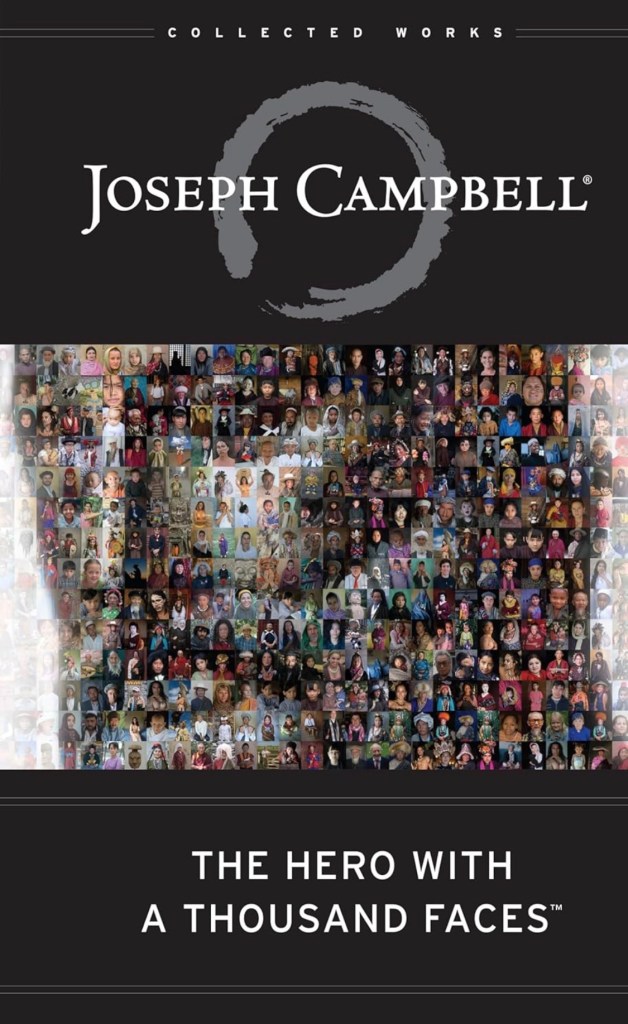
Discover the timeless wisdom of The Hero with a Thousand Faces by Joseph Campbell — a journey through myth, psychology, and the universal path of transformation.

By Joseph Campbell (1949)

Amazon link

Introduction

The Hero with a Thousand Faces by Joseph Campbell is one of the most influential books in mythology, psychology, and storytelling. It explores a universal narrative structure found across cultures — what Campbell famously called “The Hero’s Journey” or the “Monomyth.”

This framework reveals that myths from every era and region share a deep psychological pattern: a hero leaves home, faces trials, gains wisdom, and returns transformed. Campbell uses examples from ancient myths, religious stories, and modern literature to show how this timeless cycle reflects the human search for meaning.

The Structure of the Hero’s Journey

Campbell identifies three main stages of the hero’s journey — Departure, Initiation, and Return — each containing several symbolic steps.

1. Departure

The hero begins in the ordinary world before being called to adventure.

Call to Adventure: Something disrupts the hero’s normal life. Refusal of the Call: Fear or doubt may cause hesitation. Supernatural Aid: A mentor or guide offers wisdom or tools. Crossing the Threshold: The hero leaves the familiar world behind.

2. Initiation

The hero faces trials that lead to inner growth.

Road of Trials: A series of challenges test the hero’s strength and morality. Meeting with the Goddess / Temptation: The hero encounters love or temptation that tests devotion. Atonement with the Father: The hero reconciles inner conflict or authority figures. Apotheosis: The hero achieves enlightenment or transformation. The Ultimate Boon: The hero gains the prize — wisdom, knowledge, or a sacred object.

3. Return

Having transformed, the hero must bring their gift back to the world.

Refusal of the Return: The hero may want to remain in peace or bliss. Magic Flight / Rescue from Without: Obstacles arise on the way back. Crossing the Return Threshold: The hero reintegrates into society. Master of Two Worlds: Balance is found between the spiritual and material. Freedom to Live: The hero accepts life’s impermanence and lives freely.

Themes and Insights

1. Myths as Mirrors of the Mind

Campbell draws on Carl Jung’s idea of archetypes — universal symbols rooted in the collective unconscious. Myths, he argues, are psychological maps showing humanity’s shared inner journey.

2. The Journey Within

The hero’s outer adventure mirrors an inner transformation. Every trial represents a confrontation with fear, desire, or ego. Thus, myth is not only about gods and warriors — it’s about you.

3. Modern Relevance

Campbell believed that modern society’s myths — found in movies, books, and personal stories — continue to express the same ancient truths. His work profoundly influenced creators like George Lucas, who modeled Star Wars directly on the Hero’s Journey.

Why It Matters Today

In a world often fragmented by distractions and doubt, The Hero with a Thousand Faces reminds us that growth comes through struggle and self-discovery. Whether facing career change, grief, or personal evolution, we are each called to adventure — to leave comfort behind, face the unknown, and return wiser.

Campbell’s central message:

“Follow your bliss, and doors will open where there were none before.”

Personal Review

Campbell’s writing is dense but deeply rewarding. The book blends mythology, psychology, and philosophy with poetic language that feels timeless. It’s more than academic—it’s a spiritual guide to living courageously.

Pros:

Profound psychological depth Universal relevance across cultures Inspires creative storytelling and personal reflection

Cons:

Archaic language and complex references Requires patience and rereading for full understanding

Verdict:

⭐️⭐️⭐️⭐️⭐️ (5/5) — A life-changing classic that transforms how you see stories, religion, and yourself.

Conclusion

The Hero with a Thousand Faces teaches that myth is not ancient fantasy but a living roadmap for transformation. Every person who steps beyond fear, pursues meaning, and returns with wisdom becomes the hero — wearing one of the “thousand faces” of humanity.

So the question remains:

What adventure is calling you next?

Sapiens: A Brief History of Human Kind (Book Summary)

Amazon link: Sapiens

Part I: The Cognitive Revolution

(c. 70,000 – 30,000 years ago)

Chapter 1 – An Animal of No Significance

About 13.5 billion years after the Big Bang, humans appear — one species among many. 100,000 years ago, at least six human species (including Neanderthals) existed. Homo sapiens were not the strongest, but they became the most successful due to intelligence and social cooperation.

Chapter 2 – The Tree of Knowledge

Around 70,000 years ago, the Cognitive Revolution began. Humans developed complex language, myths, and imagination. This allowed large-scale cooperation — a key advantage over other species.

Chapter 3 – A Day in the Life of Adam and Eve

Examines hunter-gatherer societies before agriculture. They lived healthier and often more balanced lives than later farmers. Early humans had intimate knowledge of nature and flexible social structures.

Chapter 4 – The Flood

Humans spread worldwide and caused mass extinctions of megafauna. This chapter highlights our early ecological impact and adaptability.

🌾 Part II: The Agricultural Revolution

(c. 10,000 years ago)

Chapter 5 – History’s Biggest Fraud

Agriculture changed human life drastically — more food, but worse individual lives. People became tied to land and repetitive labor. Harari calls it a “luxury trap” — food surpluses led to population booms but not more happiness.

Chapter 6 – Building Pyramids

Agriculture led to permanent settlements and complex social hierarchies. Shared myths (religion, kingship, laws) united large groups of strangers. Harari introduces the idea of “imagined orders” — belief systems that exist only because people believe in them.

Chapter 7 – Memory Overload

Writing was invented to manage growing administrative complexity. Early scripts tracked crops, taxes, and debts — not literature. Writing made collective memory possible and enabled bureaucracies.

Chapter 8 – There Is No Justice in History

Hierarchies (class, gender, race, caste) developed to maintain order. These systems persist through imagined legitimacy rather than biological necessity.

🌍 Part III: The Unification of Humankind

(last few thousand years)

Chapter 9 – The Arrow of History

Human societies gradually unified under larger political and economic systems. Three main forces drive unification: money, empires, and religion.

Chapter 10 – The Scent of Money

Money is the purest form of mutual trust — it allows cooperation without personal relationships. Unlike religion or politics, money crosses all cultures.

Chapter 11 – Imperial Visions

Empires spread ideas, technologies, and trade — often violently, but also by blending cultures. Harari treats empires as both destructive and creative forces.

Chapter 12 – The Law of Religion

Religions evolved to justify social and political orders. Polytheism gave way to monotheism, and later to humanism and secular ideologies.

Chapter 13 – The Secret of Success

Cultural evolution favors systems that increase cooperation and adaptability. Shared myths that promote unity — not truth — tend to survive.

⚙️ Part IV: The Scientific Revolution

(since 1500 CE)

Chapter 14 – The Discovery of Ignorance

Around 1500, people began admitting ignorance and seeking knowledge. Science flourished because humans valued what they didn’t know. Harari links science with empire and capitalism — exploration funded by conquest and profit.

Chapter 15 – The Marriage of Science and Empire

Scientific exploration served imperial expansion (e.g., navigation, mapping). Empires, in turn, funded scientific discovery — a self-reinforcing cycle.

Chapter 16 – The Capitalist Creed

Capitalism relies on credit and trust in future growth. Entrepreneurs and investors became new world builders. Capitalism and science accelerated global transformation.

Chapter 17 – The Wheels of Industry

The Industrial Revolution reshaped everything — production, energy, transportation. Harari calls it an ecological and social upheaval. Consumerism replaced religion as a source of meaning for many.

Chapter 18 – A Permanent Revolution

Modernity is defined by constant change and restlessness. Traditional values erode as economies and technologies evolve rapidly.

Chapter 19 – And They Lived Happily Ever After

Explores whether humans are happier today. Despite comfort and longevity, happiness has not improved proportionally. Mental distress and alienation remain widespread.

Chapter 20 – The End of Homo Sapiens

Humanity is on the brink of biological redesign — through genetic engineering, AI, and biotechnology. We may evolve into post-human beings. Harari ends with a profound question: “What do we want to want?”

🧭 Final Takeaway

Harari’s overarching message:

Human history is the story of how shared fictions — religion, money, nations, human rights — allowed us to cooperate, dominate, and now potentially transcend our biology.

But whether that makes us happier or wiser remains uncertain.

Amazon link: Sapiens