Imagine standing beside a mountain cliff so steep that one misplaced step would be dangerous. Now picture a shaggy white animal moving across it with apparent ease. If you have ever wondered how mountain goats survive in places that seem almost impossible to reach, you are not alone.
North America’s mountain goat is one of the continent’s most remarkable high-altitude mammals. Its climbing skills are impressive, but its biology, family life, and relationship with a changing alpine landscape are just as interesting. Here are ten mountain goat facts that reveal how this hardy animal makes a living at the edge of the mountains.
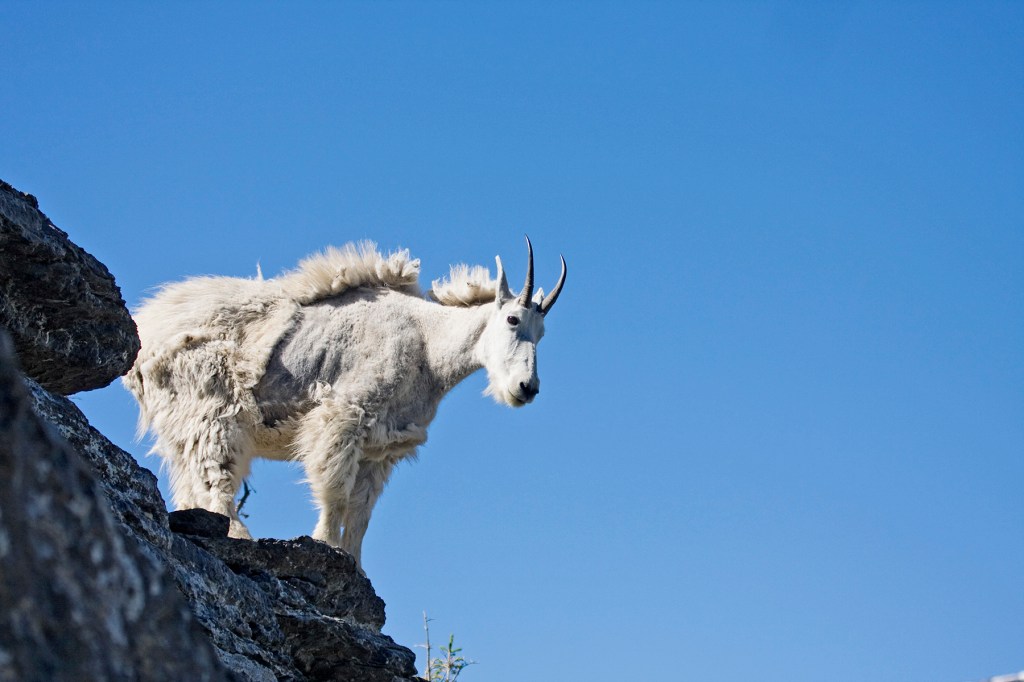
1. Mountain Goats Are Not Actually True Goats
Despite the familiar name, the mountain goat (Oreamnos americanus) does not belong to the genus Capra, which includes domestic goats. It is a member of the broader cattle-and-antelope family, Bovidae, and is more closely related to animals such as the chamois and serow.
This distinction is a reminder that common animal names do not always reflect their evolutionary relationships. Mountain goats developed a highly specialized way of life in rugged North American mountains, quite different from that of goats raised on farms.
2. Their Hooves Work Like Built-In Climbing Shoes
A mountain goat’s most extraordinary feature may be its feet. Each split hoof has a tough outer edge and a softer, rubbery pad underneath. The two toes can spread to help the animal balance on uneven rock.
Strong shoulders and a compact body provide power and stability. Together, these adaptations help mountain goats navigate slopes of 60 degrees or more, cross narrow ledges, and find secure footing where a human would need technical climbing equipment.
3. Their White Coats Are Remarkable Winter Insulation
Mountain goats wear two layers of fur: long outer hairs that help shed moisture and a dense, woolly undercoat that traps warmth. Their thick winter coat gives them their unmistakable shaggy appearance against dark alpine cliffs.
As temperatures rise, they shed much of that insulation. A mountain goat in early summer can look surprisingly ragged, with loose tufts of fur hanging from its body. That uneven coat is generally part of a normal seasonal process, not necessarily a sign of illness.
4. They Are Native to the Mountains of Northwestern North America
Wild mountain goats naturally occur in the mountainous regions of Alaska, western Canada, and parts of the northwestern United States, including the northern Rockies and Cascades. They occupy a combination of rocky cliffs, alpine meadows, and sometimes forested slopes.
Not every mountain goat population in the western United States is native to its present location. Some herds were introduced by people. That matters to conservationists because introducing a species into a new alpine ecosystem can create unexpected ecological pressures.
5. The Cliffs Are More Than a Playground—They Are Protection
Living on precipitous terrain reduces access for many land predators. Mountain goats use cliffs as escape terrain, while nearby meadows and ridges provide opportunities to feed.
This does not make them invulnerable. Falls, harsh weather, food shortages, and predators can still threaten them, especially young animals. A cliff is valuable precisely because it offers a difficult-to-reach refuge in an otherwise challenging environment.
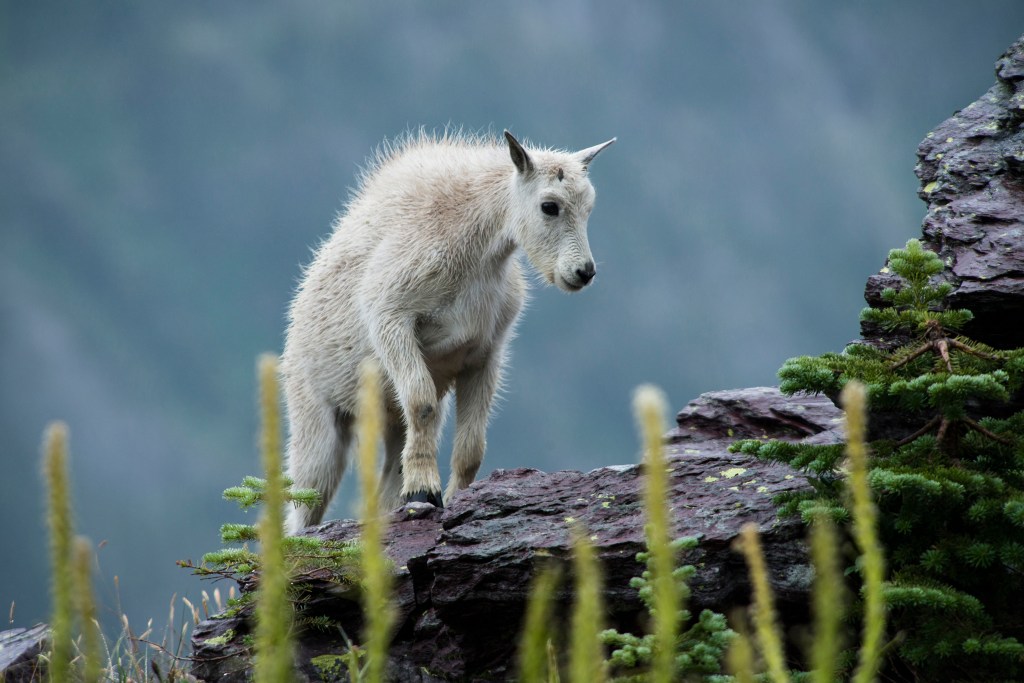
6. Baby Mountain Goats Can Stand and Move Soon After Birth
A young mountain goat is called a kid. Females, or nannies, typically give birth to a single kid in late spring after a pregnancy of roughly six months. Twins are possible but uncommon.
The newborn must become mobile quickly in a landscape that offers few safe, sheltered spaces. Kids can be on their feet within minutes, and their climbing ability improves rapidly. Mothers often choose rugged areas to give birth and later form nursery groups with other females and young.
7. They Eat a Surprisingly Wide Range of Mountain Plants
Mountain goats are herbivores, but they are not particularly picky ones. In summer, they feed on alpine grasses, sedges, flowering plants, and low shrubs. In winter, exposed shrubs, lichens, conifers, and other available vegetation may become important.
Their flexible diet is a survival strategy. In an environment where snow can cover nourishing plants for months, the ability to use many different food sources helps them remain in or near their rugged habitat throughout the year.
8. Their Black Horns Grow Throughout Life
Both male and female mountain goats have narrow, backward-curving black horns. Unlike deer antlers, these horns are not shed every year. The horn covering grows over a bony core and can show annual growth rings.
Males, known as billies, generally have heavier bodies, while females may show different horn proportions and behavior. Telling the sexes apart at a distance can be difficult, so wildlife observers should avoid relying on a single visual clue.
9. Mountain Goats Are Tough, but Their Populations Recover Slowly
Mountain goats can survive for more than a decade, yet they have a relatively slow reproductive pace. Females usually do not produce their first young until they are several years old, and they commonly raise only one kid in a breeding season.
This makes populations sensitive to losses of breeding females and to repeated poor winters. A sudden decline cannot necessarily be reversed by one good season. Protecting established herds therefore requires long-term monitoring rather than judging their health from a single year’s sightings.
10. Climate Change Is Creating New Challenges for These Alpine Specialists
Mountain goats are built for cold, rocky environments, but that specialization can become a liability when conditions shift. Changes in snowpack, vegetation, temperature, and habitat connectivity may alter where goats can find food and move safely.
Research in Alaska’s Glacier Bay region has highlighted how isolated mountain goat populations can become especially vulnerable when suitable habitat and movement corridors change. The pressures differ by region, so conservation requires local evidence rather than assuming every herd faces identical conditions.
Where Can You See Mountain Goats in the Wild?
In the United States, Glacier National Park in Montana and North Cascades National Park in Washington are well-known places to look for mountain goats. In Glacier, visitors sometimes observe them around Logan Pass or the Goat Lick Overlook, although sightings are never guaranteed.
Bring binoculars or a camera with a zoom lens. Give the animals plenty of space, never feed them, and move away if one approaches. Mountain goats are wild, powerful animals, and close contact is unsafe for both visitors and wildlife.
What Mountain Goats Can Teach Us About Adaptation
The mountain goat is a striking example of how evolution shapes an animal for a particular environment. Its feet, fur, body, diet, and behavior function together rather than as isolated tricks. Even the steep terrain that looks so dangerous to us is part of what makes its way of life possible.
There is also a cautionary lesson. A species can be wonderfully adapted to its home while remaining vulnerable when that home changes. Admiring wildlife becomes more meaningful when curiosity is paired with respect for the habitats animals depend on.
Practical Takeaways for Wildlife Lovers
- Choose a safe viewpoint and use binoculars rather than approaching goats for a better photograph.
- Learn the difference between a mountain goat and a bighorn or Dall sheep: mountain goats have relatively slender black horns and shaggy white coats.
- Stay on designated trails and follow park guidance to reduce disturbances in fragile alpine habitats.
- If you enjoy mountain wildlife, explore local natural history programs or citizen-science projects that support species monitoring.
Continue Exploring Wildlife and Nature
For another remarkable mountain animal, read our article on the elusive snow leopard. You might also enjoy why the octopus is so amazing and our guide to telling spruce from pine in the wild.
If thoughtful stories about wildlife, nature, and the human experience are your kind of reading, subscribe to Mindful Explorer for future articles.

