Imagine spending your entire life in a room where the only thing you can see is a wall of moving shadows. Everyone around you calls those shadows reality. Then, one day, someone tells you the world is far larger than you have ever imagined. Would you believe them?
That unsettling question lies at the heart of Plato’s Allegory of the Cave. Although written more than two thousand years ago, it speaks to how we form beliefs, resist unfamiliar ideas, and mistake what is familiar for what is true.
Understanding this story can help you examine your assumptions with greater curiosity. It also offers a more demanding lesson: learning is not always comfortable, and none of us can safely assume we see the whole picture.
What Is Plato’s Allegory of the Cave?
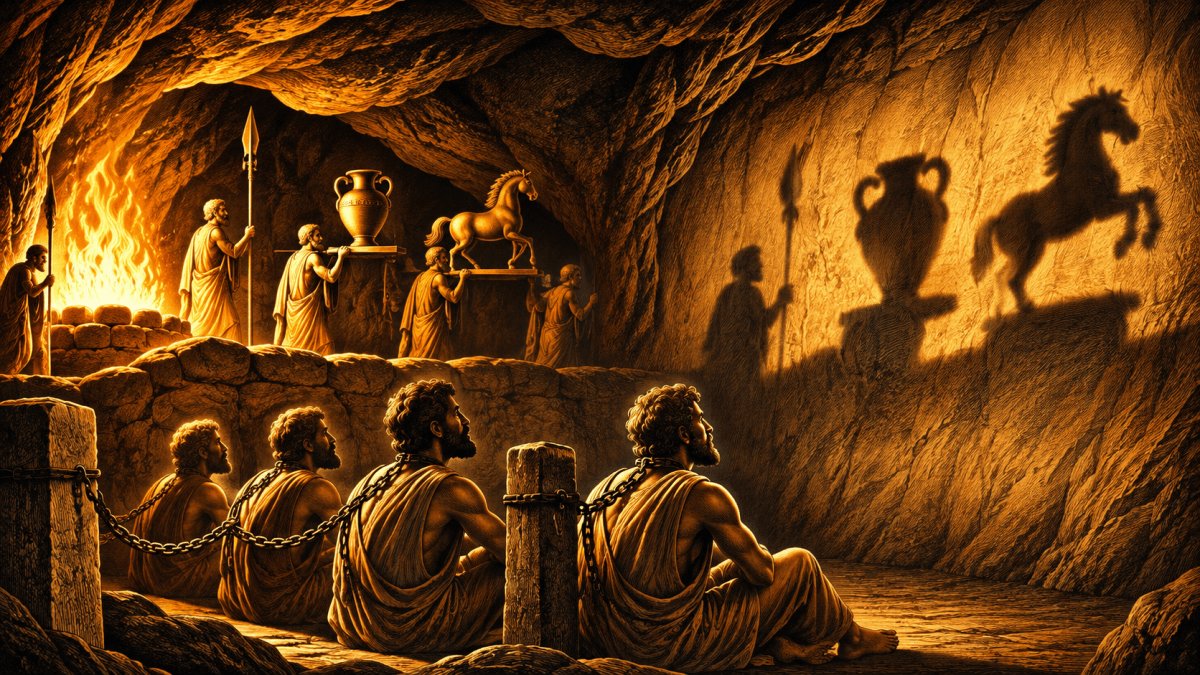
The allegory appears in The Republic, Book VII. Plato presents it through a conversation in which Socrates asks Glaucon to imagine people who have been chained inside a cave since childhood.
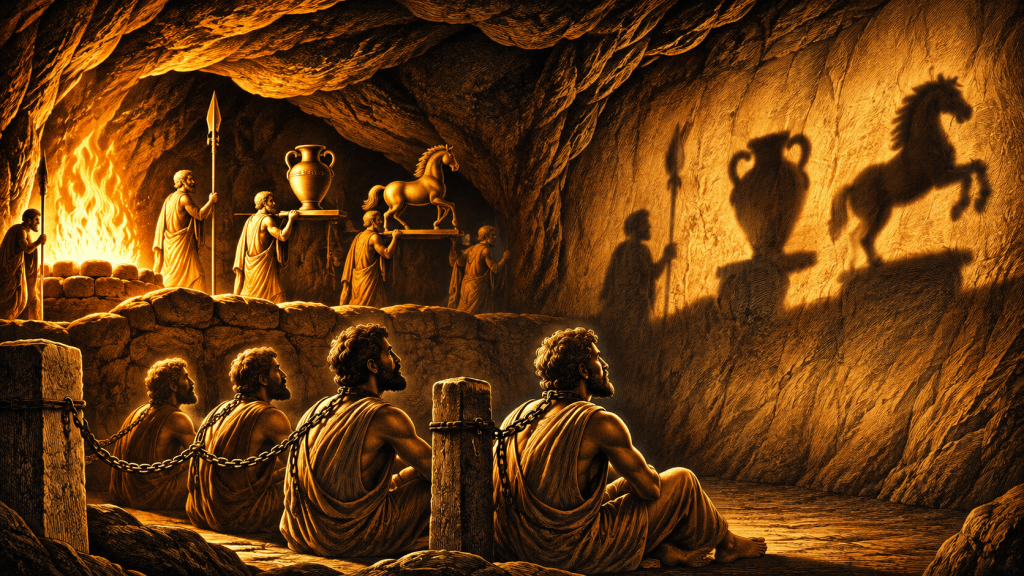
The prisoners are unable to turn their heads. They face a stone wall, while a fire burns behind them. Between the fire and the prisoners, other people carry objects along a raised path. These objects cast moving shadows onto the wall.
The prisoners see the shadows and hear echoes, but they cannot see what causes them. Because this is all they have ever known, they take the shadows to be reality itself.
A prisoner sees the outside world
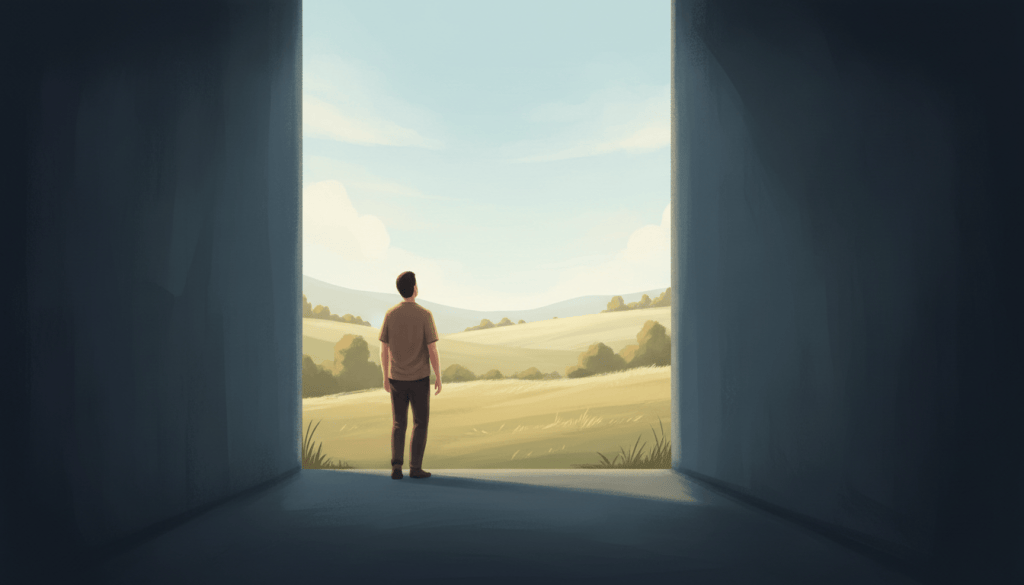
Now imagine that one prisoner is released. Turning toward the fire hurts his eyes. Seeing the objects that produce the shadows is confusing, not immediately liberating.
When he is led outside, the sunlight is almost unbearable. Gradually, his vision adjusts. He notices reflections, then ordinary objects, then the night sky, and eventually the sun.
His understanding of the world has changed. What once seemed complete was only a small part of a much richer reality.
The difficult return to the cave
The story does not end with personal enlightenment. The freed prisoner returns to the cave, where his eyes struggle to readjust to the darkness. The others interpret his difficulty as evidence that leaving was a mistake.
When he tries to explain what lies outside, they ridicule him. Plato even suggests that prisoners might kill someone who attempted to free them. The image is disturbing because it shows how threatening a new perspective can feel.
What Do the Shadows, Cave, and Sun Symbolize?
Plato uses this physical journey to explore a philosophical one. Several parts of the story carry distinct meanings:
- The shadows: Appearances and opinions that people accept without understanding their causes.
- The chains: The limits imposed by habit, ignorance, and an unexamined way of seeing.
- The ascent: Education as a difficult transformation in how a person understands reality.
- The world outside: Deeper knowledge reached through intellectual inquiry, rather than appearances alone.
- The sun: Plato’s Form of the Good, his idea of the ultimate source of intelligibility and value.
The last point matters. Plato is not merely telling us to collect more facts or to distrust our eyesight. His allegory belongs to a larger account of knowledge, goodness, and the difference between what seems true and what can be understood through reason.
Why Is Leaving the Cave So Difficult?
One of the story’s most recognizable details is the prisoner’s resistance to the light. He does not immediately welcome a better explanation. His familiar world feels safer.
Modern psychology provides useful parallels, though Plato was not describing today’s scientific theories.
We prefer information that fits our beliefs
Confirmation bias describes our tendency to seek, notice, or favor evidence that supports what we already believe. When an idea feels obvious, we may stop checking whether it deserves our confidence.
The cave invites us to ask a difficult question: How much of what I call common sense is simply the view I have practiced seeing?
Beliefs are tied to belonging
Opinions are not always isolated thoughts. They can be connected to family, community, professional identity, and friendships. Changing our minds may feel like risking a place among people we care about.
That is one reason respectful conversation matters. Being challenged is easier when it does not also feel like being humiliated.
Learning can make us feel less certain
A student sometimes begins a subject believing it is simple. After studying it seriously, the student discovers how much remains unknown. That temporary loss of certainty is not necessarily failure; it may be evidence of a growing understanding.
Plato’s Cave in the Age of Social Media
Our screens offer an especially vivid modern comparison. A news feed, search result, or short video can show us a small selection of events while creating the impression that we have seen the whole situation.
Algorithms often organize what reaches us according to signals such as prior engagement. Friends and communities also shape which ideas we hear repeatedly. These influences can narrow our perspective without making every piece of content false.
Imagine forming a strong opinion about a complicated issue after watching several emotionally charged clips. You may have seen something real, yet still be missing essential context. The shadow is not necessarily a lie; it may be an incomplete picture.
Your own feed is not the only possible cave. The more important question is whether you remain willing to look beyond it.
Education Means Learning to Turn Around
Plato offers a striking understanding of education. Rather than treating it simply as placing information into an empty mind, he describes it as turning the whole person toward what is worth understanding.
That idea still feels relevant in classrooms, workplaces, and ordinary conversations. Memorizing an answer is different from understanding why the answer makes sense. Repeating a viewpoint is different from being able to explain it, test it, and revise it.
A good teacher does more than supply conclusions. A good learner practices asking better questions, recognizing weak explanations, and staying engaged when a problem turns out to be complicated.
The goal is not to produce people who think exactly alike. It is to help people reason more carefully about a shared world.
How to Apply Plato’s Cave to Everyday Life
You do not need to abandon your beliefs or withdraw from technology to benefit from the allegory. Begin with a few manageable habits.
1. Identify a shadow
Choose one belief you hold with strong confidence. It could concern your abilities, a relationship, a social issue, or what a successful life should look like. Write down what you believe and how you came to believe it.
2. Separate observation from interpretation
Ask what you directly witnessed and what you inferred. For example, “A friend has not replied” is an observation. “My friend is upset with me” is one possible interpretation. Keeping those apart creates room for other explanations.
3. Look for a thoughtful counterargument
Read or listen to a serious explanation from someone who disagrees with you. Avoid deliberately weak or sensational examples. Try to describe their reasoning in a way they would recognize as fair.
4. Follow evidence beyond the first impression
When a claim matters, check its original source, its context, and whether credible independent evidence supports it. Do not let a vivid story substitute for a reliable explanation.
5. Practice being uncertain without becoming passive
Try saying, “This is what I currently think, and here is what might change my mind.” You can make practical decisions while admitting that your knowledge is incomplete.
Curiosity Is Not the Same as Cynicism
There is an important trap in modern interpretations of the cave: believing that everyone else is deceived while you alone possess the truth.
That attitude simply replaces one set of shadows with another. Radical suspicion is not the same as careful inquiry, and the loudest person promising to reveal a hidden reality may be offering a misleading story of their own.
A healthier response is intellectual humility. Look for good reasons, remain open to correction, and give other people the dignity of being fellow learners rather than prisoners to be rescued.
The Deeper Lesson: Seeing More and Returning with Compassion
The freed prisoner’s journey is not only about personal insight. His return reminds us that knowledge brings a responsibility to other people, even when communication proves difficult.
You may have experienced something similar after learning about mental health, changing an old habit, discovering another culture, or reconsidering a belief you once defended. A new perspective can be meaningful, but explaining it to someone else takes patience.
Perhaps the most useful way to carry Plato’s story into your life is to remain both curious and kind. Question appearances, but do not assume disagreement proves ignorance. Seek a wider view, and remember how long it can take for anyone’s eyes to adjust.
The cave ultimately leaves us with a small but powerful question: What have I accepted as reality simply because it is all I have been shown?
Related Reading from Mindful Explorer
- Marcus Aurelius: Stoic Wisdom for a Noisy Modern World — on perspective and examining our reactions.
- Why Smartphone Boundaries Are an Act of Self-Respect — on protecting attention in a screen-filled world.
- The Philosophy of Acting: What Pretending Teaches Us About Life — on perspective-taking and human interpretation.
For the original passage, you can read Plato’s Republic, Book VII.
If you enjoy thoughtful explorations of psychology, meaning, and everyday awareness, subscribe to Mindful Explorer for future articles.

