It is widely known that we live in a culture of imitation. Monkey see, monkey do. There is a virtue and a vice to be found in this cultural phenomenon. The vice is that if you decide to do something that is not extremely smart, can be considered risky, dangerous, malicious, or deviant, it may cause others around you to try the same; whether or not they have the abilities to accomplish such a feet.
For example, I worked at a summer camp with children between the ages of 5 and 13. The camp had a rule that the children were not aloud to climb on the top of the monkey bars. Throughout the entire summer, I would have to reiterate this rule to an 11 year old camper. A week would not go by where I didn’t have to discuss with him the reasons that we needed to stay off the top of the monkey bars. Every time I would talk with him I would explain that I knew he had the skills to perform such and activity safely however, I told hem that the younger children were in danger of getting seriously hurt if they tried it. I explained that if they see him climbing on top of the monkey bars, then they will think it is okay to do the same.
Sure enough, toward the end of the summer, a six year old girl tried climbing up to the top of the monkey bars. She then fell face first onto the platform attached to the monkey bars. She got a nice swollen bloody lip, but fortunately was not seriously injured.
Now this concept goes past imitation and dives a little deeper into what is called observational learning. In 1961, famous psychologist Albert Bandura conducted an experiment at Stanford University that is still relevant in learning today. In a controlled lab, Bandura set up some toys for children to play with. One child would be observed at a time. Some of the children would then observe an adult behaving aggressively against a bobo doll. The adult would punch, kick, or throw the doll.
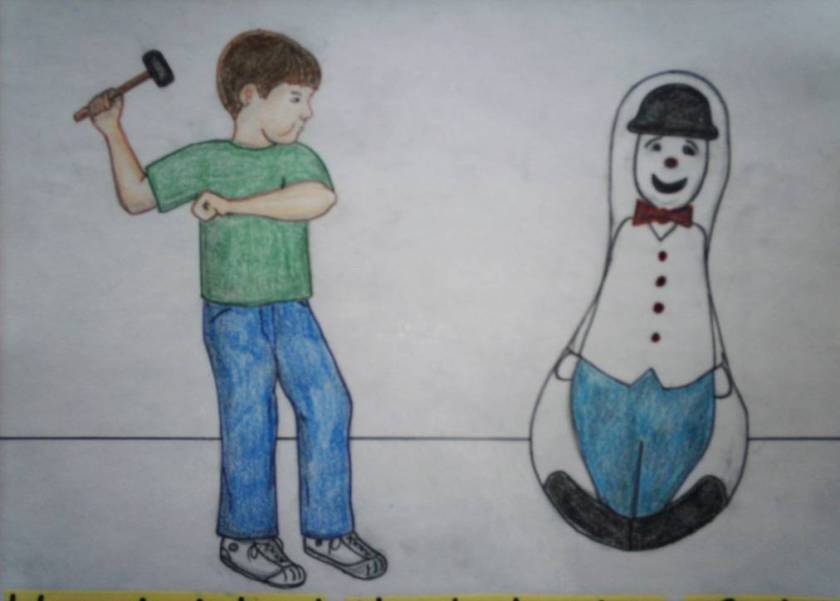
It was found that the children who witnessed this aforementioned aggressive behavior, would mimic it and would furthermore improvise new ways to use the doll. For example hitting the doll with another toy baby doll. On the other hand, children who were not exposed to this aggressive behavior did not show aggression towards the doll.
Therefore, it is not far fetched to conclude that if you model aggressive or deviant behavior around others, developing minds may be susceptible to adopting such behavior. Conversely, we can infer that modelling positive behaviors will in turn help others to adopt such beneficial mannerisms.
McLeod, S. A. (2014). Bobo Doll Experiment. Retrieved from http://www.simplypsychology.org/bobo-doll.html
 Mindful Explorer